Every team eventually hits the same Wednesday: a new hire runs npm install, the native module compiles against the wrong OpenSSL, and three hours disappear. The root cause is not Node — it is that your development environment is implicit: a pile of system packages, shell history, and tribal knowledge that nobody wrote down.
Nix solved this fifteen years ago by making environments pure and hash-addressed. The problem was never Nix’s model; it was Nix’s interface. Three projects now wrap that model in something a normal engineering team will actually use: Devbox, devenv, and Flox. They look similar from a README. They diverge hard once a team of ten depends on them.
Quick Verdict (TL;DR)
- Devbox if you want the lowest-ceremony path:
devbox.json, one command, Nix packages and a shell. Best for application teams who want determinism without learning Nix. - devenv if you want a full local stack — databases, processes, language toolchains, git hooks — declared in one Nix file. Best for teams already comfortable editing a Nix expression.
- Flox if environments must be shared across an organisation and activated per project without touching the developer’s global shell. Best for platform teams standardising many repos.
All three are self-hostable in the sense that matters: the environment definition lives in your git repo, and any binary cache can be self-hosted, so no vendor sits in your build path.
How They Compare
| Dimension | Devbox | devenv | Flox |
|---|---|---|---|
| Config file | devbox.json | devenv.nix | manifest.toml + flox.nix-style env |
| Config language | JSON | Nix | TOML (Nix under the hood) |
| Package source | Nixpkgs via Nixhub | Nixpkgs | Flox catalog (Nixpkgs-based) |
| Multi-language toolchains | Add per package | First-class languages.* options | Install packages individually |
| Background services | devbox services | services.postgres, processes.* | flox services start |
| Shell activation | devbox shell | devenv shell / direnv | flox activate |
| Process manager UI | — | process-compose (TUI) | — |
| Build & publish artefacts | Partial (Dockerfile generation) | devenv tasks + Nix builds | flox build / flox publish |
| GitHub stars | 12,480 | 7,848 | 4,217 |
| Language | Go | Rust | Rust |
| Last commit | 2026-11-23 | 2026-11-25 | 2026-11-25 |
| Learning curve | Lowest | Medium (Nix syntax) | Low–medium |
| Best for | App repos, fast onboarding | Complex local stacks | Org-wide standardisation |
Star counts and commit dates pulled live from the GitHub API on 2026-11-26.
Which One For Which Job
| Your situation | Pick | Why |
|---|---|---|
| 12-person product team, one monorepo, Node + Postgres | Devbox | devbox.json is readable by everyone, no Nix syntax |
| Local stack needs Postgres + Redis + a worker + migrations | devenv | Services and processes are declarative, one devenv up |
| Platform team supporting 40 repos | Flox | Environments activated per project, publishable to the org |
| You want CI to use the exact same toolchain | Any — all three pin inputs | Determinism comes from the lockfile, not the CLI |
| Windows laptops in the mix | Devbox or Flox (WSL2) | Both document WSL2 paths; devenv assumes Linux/macOS |
| You already write Nix flakes | devenv | It is a flake with batteries |
| You want the smallest possible diff in review | Devbox | A JSON package list is trivially reviewable |
Devbox — Determinism With the Least Ceremony
Devbox’s bet is that most teams do not want to learn Nix; they want the outcome. You get a JSON file listing packages, and Devbox resolves them through Nixpkgs pins, generating the Nix plumbing for you.
Install and start:
| |
The resulting devbox.json is short enough to review in a pull request:
| |
That is the entire pitch, and it is a good pitch. A new developer clones the repo, runs two commands, and gets the pinned Python — not whatever Homebrew decided was current. Adding devbox add nodejs@22 postgresql@16 redis extends it without a Nix expression in sight. Services get their own subcommand, and Devbox can generate a Dockerfile from the same definition when you need the environment in a container.
Where it shows limits: complex conditional logic. Devbox is deliberately not a programming language, so “install this package only on aarch64 macOS” or “run this setup script only when the database is empty” pushes you into shell hooks and out of the declarative model. That is the moment to look at devenv.
devenv — The Full Local Stack, Declared
devenv is the opposite trade: you write Nix, and in exchange you get a single file that describes an entire development stack — toolchains, services, processes, scripts, tasks, git hooks and tests. For teams that already tolerate a flake.nix, this is the most capable of the three.
devenv init scaffolds a devenv.nix like this (trimmed to the parts people actually use):
| |
Then devenv shell puts you in the environment, and devenv up starts the declared processes under a process-compose TUI — which is the feature that sells it: your Postgres, your queue worker and your dev server start together, with logs in one pane, and stop together when you leave.
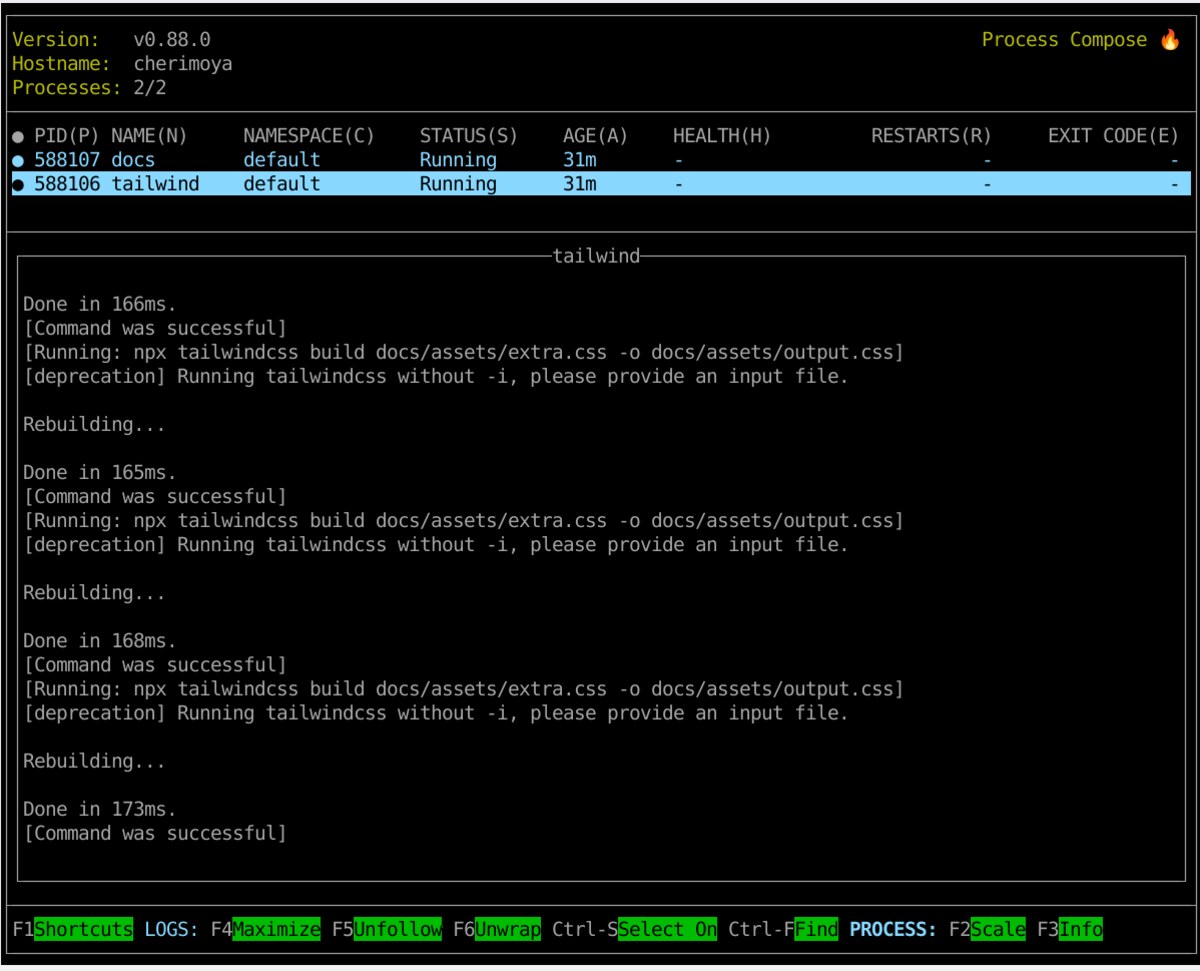
The costs are real. Nix is a language with a learning curve, and a devenv.nix that grows to 300 lines becomes its own maintenance project. Debugging a failed activation means reading Nix error messages, which are famously unhelpful. And because everything is a flake, an unpinned inputs bump can change your whole stack — pin them and update deliberately.
The payoff is that devenv is the only one of the three where “spin up the whole stack” is a first-class, one-command operation. If your onboarding doc currently has fourteen steps, this removes thirteen of them.
Flox — Environments as a Shareable Organisational Asset
Flox targets a different unit of reuse: not “this repo’s shell” but “our organisation’s environments”. You create an environment in a project, install packages into it, activate it, and — unusually — build and publish packages from it so other teams can install them.
The workflow from the project README:
| |
The mental model is explicit and worth quoting: tools appear when you activate, and disappear when you leave. Each project gets an isolated environment, the definition lives in a file you commit, and nothing leaks into the developer’s global shell. For a platform team maintaining dozens of repos, that isolation is the whole value proposition — you can standardise without dictating anyone’s dotfiles.
Flox’s constraint is ecosystem maturity relative to the other two: fewer third-party integrations, a smaller community, and a catalog that is Nixpkgs-derived but curated. It is also the most opinionated about workflow. If your team wants to hand-tune a shell, Flox will feel like a cage; if your team keeps breaking each other’s environments, the cage is the feature.
The Pitfalls Nobody Documents
1. A lockfile is not a cache. All three pin inputs, so the definition is reproducible — but the first build on a fresh machine still downloads or compiles from Nixpkgs. Without a binary cache, a Rust toolchain can mean a 25-minute first activation. Self-host a cache (see our Nix binary cache guide) before you roll this out to a team.
2. direnv is where the sharp edges live. Auto-activation via direnv is lovely until a hook runs cd, prints output, or breaks an IDE’s terminal. Always provide a documented --no-direnv path (devenv shell, devbox shell, flox activate) so people can escape.
3. macOS aarch64 is not Linux x86_64. Cross-platform teams hit divergence constantly: a package that builds on Linux may be marked broken on Darwin. Test the environment on both platforms in CI, not just on the laptops of whoever wrote it.
4. Do not put secrets in the environment definition. env.GREET-style values are committed. Use a secrets manager or an untracked local file; a devenv.nix with a database password in it will be in git history forever.
5. Shell hooks are code. enterShell and scripts.* run on every activation — including in CI. A hook that installs packages from the network turns a deterministic environment back into a nondeterministic one.
6. Migration is not free. Moving an existing team off brew/apt plus a setup.sh means reconciling years of undocumented state. Start with one repo, and expect the first week to be about missing system libraries, not about Nix.
Why Self-Host Your Development Environment
The pitch for these tools is usually “onboarding speed”, which undersells it. The real benefit is that your environment becomes reviewable. A devbox.json or devenv.nix in the repo is a diff a reviewer can read; a wiki page listing brew installs is folklore. When the environment is code, “it works on my machine” stops being an excuse and starts being a bug report.
Self-hosting the supporting pieces — a binary cache, a package mirror, CI runners — keeps the whole chain inside your infrastructure, so a vendor outage cannot block a deploy. That matters more as the environment definition becomes load-bearing for CI. If reproducibility is a research requirement rather than a product one, our reproducible research platforms guide covers the hosted-notebook side of the same problem, and the Devbox vs Nix vs dev containers breakdown covers the container-first alternative.
FAQ
Is Devbox just a wrapper around Nix?
Effectively yes, and that is the point. Devbox resolves packages from Nixpkgs, generates the Nix profile, and hides the expression language. You can inspect the generated Nix if you need to, but day-to-day work happens in devbox.json.
Can devenv replace Docker Compose for local development?
For many stacks, yes: services.postgres.enable = true plus devenv up gives you a database and your app processes with one command and no images to build. It does not replace Compose for testing multi-container networking or production-like deployments.
Does Flox require a paid account to self-host?
The CLI and environment definitions work locally without an account. flox publish — sharing built packages with a team — is where the hosted service becomes relevant; check current terms before designing a workflow that depends on it.
Which one is fastest on a cold machine?
All three are limited by Nix substitution. With a warm binary cache, activation is a couple of seconds; without one, expect minutes. This is a caching problem, not a tool-choice problem — do not pick a tool based on cold-start benchmarks.
Can I use these in CI?
Yes, and it is the strongest argument for adopting one. devbox run, devenv test and flox activate -- <command> all give CI the same toolchain your developers use, which eliminates the “passes locally, fails in CI” class of failures.
What happens if the project is abandoned?
Your environment definition is pinned and your packages come from Nixpkgs, so an abandoned wrapper does not break your builds — you can migrate to a plain flake. That portability is the main reason to prefer tools that keep the underlying Nix expression inspectable rather than fully opaque.
💰 想测试你的市场判断力?我用 Polymarket 做预测市场交易——这是全球最大的预测市场平台,从大选结果到技术监管时间线,什么都可以押注。和赌博不同,这是真正的信息市场:你懂的信息越多,胜率越高。我靠预测技术相关事件的走向已经赚了不少。用我的邀请链接注册:Polymarket.com