Your build server and your laptop disagree about which version of OpenSSL is installed. Your Docker image was reproducible last Tuesday and mysteriously isn’t today. A dependency you never declared got upgraded because something in node_modules pulled it in sideways.
This is the problem declarative package management actually solves — not by pinning versions in a lockfile that describes what you want, but by making the entire dependency graph, including the compiler and libc, a first-class content-addressed value. Two systems have done this properly for over a decade: Nix and GNU Guix. Both are alive, both shipped releases in 2026, and both will happily run your infrastructure. They are also very different in ways that matter once you’re past the tutorial.
TL;DR — Quick Verdict
Choose Nix if you want the ecosystem. Nix has 17,978 GitHub stars on the core, 26,736 on nixpkgs, a package set well past 100,000 definitions, native Docker images, and every third-party deployment tool (Colmena, deploy-rs, nixops) targets it. It is the pragmatic choice for production servers in 2026.
Choose Guix if you want the ideology to be load-bearing. Guix is GPL-3.0, bootstrappable from a 357-byte binary seed, written in Guile Scheme, and refuses to ship anything that isn’t free software by default. It’s the only system where “auditable from source” is literally true rather than aspirational.
If you just want reproducible dev shells and don’t care about the OS layer, use Nix — the tooling gap is not close. Guix wins on principle and auditability; Nix wins on everything you’ll touch on a Tuesday afternoon.
Head-to-Head Comparison
| Dimension | Nix / NixOS | GNU Guix / Guix System |
|---|---|---|
| Core repo | NixOS/nix — 17,978 ⭐ | Self-hosted on Codeberg; GitHub mirror obsolete (271 ⭐) |
| Package set | nixpkgs — 26,736 ⭐, 100,000+ definitions | ~24,000 packages |
| Latest release | Nix 2.35.4 (tags, no GH releases) | Guix 1.4.x series |
| Last commit | 2026-11-06 | Active (Codeberg) |
| License | LGPL-2.1 | GPL-3.0 |
| Implementation language | C++ (with a lazy functional evaluator) | Guile Scheme |
| Init system | systemd | GNU Shepherd |
| Declarative OS | NixOS | Guix System |
| Pinning mechanism | flake.lock (content-addressed) | channels.scm + guix time-machine |
| Docker support | Official nixos/nix image | guix pack -f docker |
| Non-free software | Opt-in via allowUnfree | Separate nonguix channel |
| Learning curve | Steep (Nix language) | Steeper (Scheme + functional OS config) |
| Ecosystem / third-party tooling | Large | Small but coherent |
The star counts are live as of this writing. Note the Guix number: the GitHub repository guix-mirror/guix states plainly that it is an obsolete mirror and that development moved to Codeberg. If you evaluate Guix by GitHub activity you will draw exactly the wrong conclusion.
Decision Matrix — Pick in 10 Seconds
| Your situation | Pick | Why |
|---|---|---|
| Production Linux fleet, need config management | NixOS + Colmena | Mature deploy tooling, systemd, large package set |
| Reproducible CI containers | Nix flakes | flake.lock pins the whole graph; official Docker base |
| Strict free-software compliance or audit trail | Guix | GPL-3.0, bootstrappable, no binary blobs by default |
| Academic/HPC environment already using Scheme tooling | Guix | Shepherd + Guile integrate with existing workflows |
| You need a package that isn’t in the repo | Nix | Far more likely to already exist |
| You want to learn one and never revisit | Nix | Bigger community means more answers when stuck |
| Embedding reproducible builds into an existing distro | Guix pack | Produces relocatable tarballs/docker without changing the host |
| Long-term archival rebuild of old software | Guix time-machine | Can reconstruct a 2019 environment exactly |
Nix — The Ecosystem Play
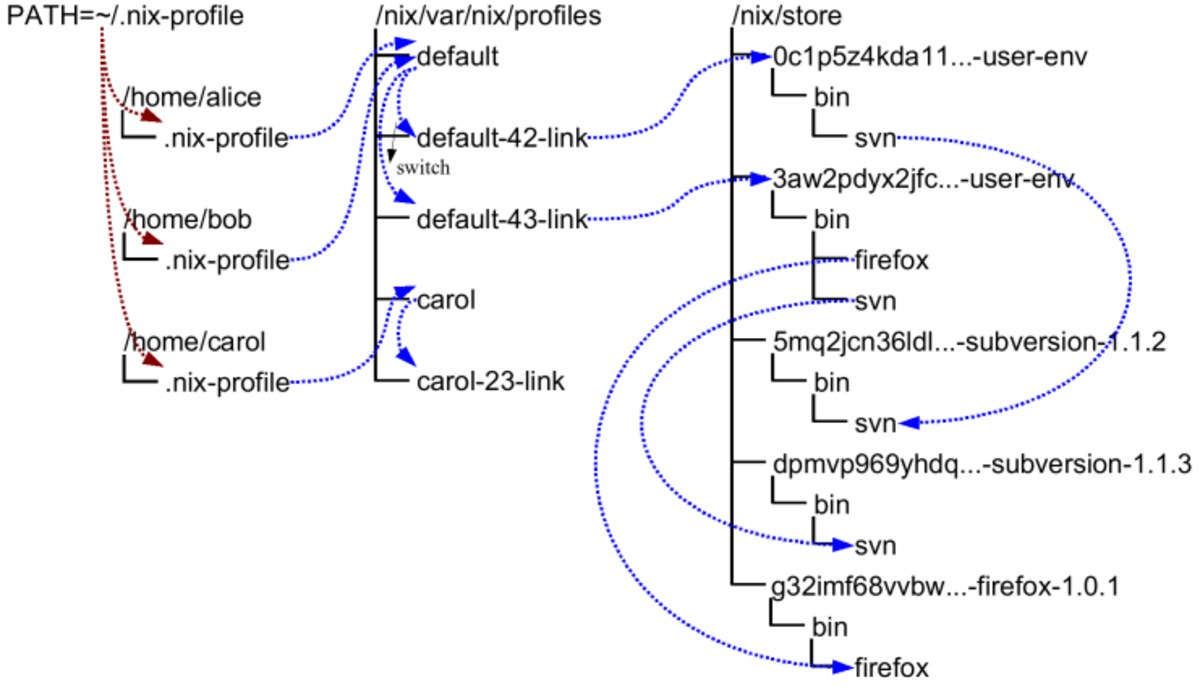
Nix treats a package as a pure function of its inputs. The store path /nix/store/<hash>-openssl-3.x embeds a hash of everything that went into producing it, so two builds with identical inputs land on the identical path — and any difference in inputs produces a different path instead of silently overwriting.
Install on any Linux or macOS host:
| |
The --daemon flag sets up the multi-user installation, which is what you want on a server: builds run as an unprivileged nixbld user and the store is writable only by the daemon.
Flakes: the pinning mechanism that actually works
A flake is a directory with a flake.nix that declares its inputs and outputs. flake.lock records the exact revision of every input, so nix build on a colleague’s machine three months later resolves the same graph.
| |
Day-to-day usage is three commands:
| |
Because go, postgresql_17, and the exact glibc are all store paths, nix develop gives every engineer byte-identical toolchains. No version manager, no “did you install Go 1.23 or 1.24”, no asdf plugin roulette.
NixOS for servers
NixOS makes the entire machine a declarative value. /etc/nixos/configuration.nix declares users, services, firewall rules, and kernel parameters; nixos-rebuild switch builds a new system generation and flips a symlink. Rollback is nixos-rebuild switch --rollback and takes about two seconds — the previous generation is still in the store, untouched.
For multi-host fleets, pair NixOS with a deployment tool. Our Nix deployment systems comparison covers Colmena, deploy-rs, and nixops in depth, and the binary cache guide explains how to avoid rebuilding everything on every host.
A usable container base is one line:
| |
GNU Guix — The Auditable Play
Guix is Nix’s ideas reimplemented in Guile Scheme with a hard commitment to software freedom. Its distinguishing feature is bootstrappability: the entire distribution can be rebuilt from a 357-byte binary seed, using a staged sequence of increasingly capable compilers. No opaque binary blobs hide at the bottom of the trust chain.
Install via the official script:
| |
Package operations mirror Nix’s:
| |
guix time-machine is the feature that quietly justifies the whole system for archival work: you can reconstruct an environment as it existed on a specific date, because the channel file pins every package definition and the Guix revision that evaluated them.
Producing containers without Docker as a build dependency
Guix doesn’t need a Docker daemon to emit a container:
| |
The -S /bin=bin flag creates the /bin symlink that most images assume exists. This produces a genuinely minimal image because only the closure of nginx is included — no shell, no package manager, no base OS.
Guix System
The OS layer is a Scheme record. This is a complete, bootable server definition:
| |
guix system reconfigure /etc/config.scm builds and activates it; the previous generation stays selectable at the GRUB menu. The init system is GNU Shepherd, not systemd — a Scheme-based service manager that is elegant, far smaller, and the single biggest practical adjustment for anyone arriving from a conventional distro.
Where Both Systems Bite You
These are the traps that cost real hours, not the ones in the marketing pages.
Store growth is unbounded. Every generation, every dev shell, every nix build leaves content in /nix/store forever until you collect it. On Nix: nix-collect-garbage -d deletes all old generations; nix store gc is the gentler current form. On Guix: guix gc -d 30d deletes generations older than 30 days. A default cloud VM with a 20 GB disk will fill up within weeks of active flake development. Mount /nix or /gnu on a separate volume from day one.
Shebangs and hardcoded paths break. Scripts that begin #!/bin/bash or reference /usr/bin/env python3 fail inside a pure build sandbox, because those paths don’t exist. Fix shebangs with patchShebangs on Nix or patch-shebang phases on Guix, and never hardcode interpreter paths in your own scripts.
Non-free software is deliberately awkward — and this is where the two systems diverge sharply. Nix requires nixpkgs.config.allowUnfree = true;. Guix requires adding the nonguix channel, which the project does not endorse. If you depend on a proprietary firmware blob, a vendor JDK, or NVIDIA drivers, budget an afternoon for either.
/etc is not yours to edit. On both systems, hand-editing files under /etc produces changes that vanish at the next rebuild. Declare them via environment.etc (Nix) or extra-special-file / service configuration (Guix). This is the single most common migration failure for teams coming from Ansible-managed hosts.
Flake locks don’t update themselves. nix flake update is a deliberate action. Teams that never run it accumulate a year of frozen dependencies and then face one enormous, unbisectable upgrade. Schedule it quarterly.
Guix’s package set is roughly a quarter the size of nixpkgs, and packages that exist may lag upstream by months. Check availability before committing to the migration, not after.
Why Bother With Either?
The case is operational, not aesthetic. When a CVE lands in glibc, you want to answer “which of my 40 hosts are affected” in one query rather than 40 SSH sessions. When a build breaks, you want the previous artifact still addressable so rollback is a symlink flip. When an auditor asks what’s in the production image, you want a derivation graph rather than a docker history output full of RUN apt-get install layers.
Both systems deliver that. Nix delivers it with a large community, a familiar init system, and near-total package coverage. Guix delivers it with a stronger guarantee about what’s actually inside the binary you’re running.
If you’re still deciding how far to go, our comparison of devbox, Nix, and dev containers is the lighter-weight starting point — it covers adopting reproducible toolchains without taking on a new OS.
FAQ
Is Guix just a Nix clone?
No. Guix shares the functional-derivation model and the content-addressed store concept, but it is an independent implementation in Guile Scheme, uses GNU Shepherd instead of systemd, has its own package definitions, and enforces free-software policy by default. The two are conceptually siblings and operationally incompatible — you cannot mix a Nix store and a Guix store.
Can I run Nix or Guix on an existing Ubuntu or Debian server?
Yes, both install as a package manager alongside your existing system, without replacing it. Nix’s --daemon installer and Guix’s install script both work on a conventional distro. The OS layer (NixOS, Guix System) is a separate, optional commitment.
Which one produces smaller container images?
Guix typically produces smaller images for simple services because guix pack -f docker includes only the exact closure of the requested package — no shell, no package manager. With Nix you can achieve similar results using dockerTools.buildImage with a minimal contents list, but the default nixos/nix base image is a full toolchain and should never be your production base.
How much disk space does the store actually use?
A fresh NixOS installation with a few services sits around 4–8 GB. Active flake development adds several GB per week until garbage collection runs. Guix is comparable. Treat 40 GB as a realistic minimum for /nix or /gnu on a development machine, and enable automatic GC (nix.gc.automatic on NixOS) from the start.
Do either of these work on ARM and in CI?
Both support aarch64-linux and x86_64-linux fully, and both have darwin support (Nix natively, Guix experimentally via arm64 ports). For CI, the practical pattern is a binary cache: build once on a trusted builder, push to a cache like Attic or Cachix, and let every other machine substitute rather than rebuild.
Which should I learn in 2026 if I only learn one?
Nix. The tooling ecosystem, the volume of written material, and the odds that your next employer already uses it all favor Nix. Learn Guix afterward if you care about bootstrap auditability or work in free-software-committed environments — the mental model transfers almost entirely, and Guix’s Scheme configuration is arguably the more pleasant of the two once it clicks.
💰 想测试你的市场判断力?我用 Polymarket 做预测市场交易——这是全球最大的预测市场平台,从大选结果到技术监管时间线,什么都可以押注。和赌博不同,这是真正的信息市场:你懂的信息越多,胜率越高。我靠预测技术相关事件的走向已经赚了不少。用我的邀请链接注册:Polymarket.com