A two-person team deploys a background worker and ends up babysitting four containers, a broker cluster, and a scheduler process nobody on the team fully understands. That is the Celery tax, and it is why so many Python projects now reach for something smaller. The genuinely underrated alternative tier has three members, and every one of them shipped code within the last week: Huey (6,044 stars), Taskiq (2,355 stars), and Procrastinate (1,417 stars). They occupy three different points on the simplicity-versus-async spectrum, and choosing wrong means either rewriting your worker layer in six months or paying for a broker you never needed.
TL;DR: If you want a small, boring, zero-dependency queue that runs happily on the Redis or SQLite instance you already have — and you want an admin UI for free — pick Huey. If your application is already fully async and you need native async def tasks with FastAPI-style dependency injection, pick Taskiq. If you already run PostgreSQL and refuse to operate a second piece of stateful infrastructure, pick Procrastinate. All three handle retries, scheduling, and results. None of them will ask you to become a distributed-systems operator.
Why the Broker Question Decides Everything
Before comparing APIs, understand the structural difference. Task queues differ mainly in where the queue lives:
- Huey treats the broker as pluggable. Redis, Valkey, PostgreSQL, SQLite, the filesystem, or plain memory — all supported, zero required dependencies. If you have a database, you have a queue.
- Taskiq is broker-first and async-first. You pick a broker library: NATS JetStream, Redis, RabbitMQ, or Kafka. That flexibility is the point; it also means you operate that broker.
- Procrastinate makes one bet: PostgreSQL is the queue. Job definitions, locks, and dispatch all live in your existing database, using its transactional semantics for safety.
That single design choice cascades into operational reality. Huey and Procrastinate can both be deployed with nothing but what you already run. Taskiq’s power scales with the broker you give it — and so does its operational surface.
Feature Comparison at a Glance
| Dimension | Huey | Taskiq | Procrastinate |
|---|---|---|---|
| GitHub stars | 6,044 | 2,355 | 1,417 |
| Last commit | 2026-10-11 | 2026-10-12 | 2026-10-12 |
| License | MIT | MIT | MIT |
| Broker options | Redis/Valkey, PostgreSQL, SQLite, file, in-memory | NATS, Redis, RabbitMQ, Kafka | PostgreSQL 13+ only |
| Async support | Sync-first (threads/greenlets) | async def native | Both sync and async |
| Required dependencies | Zero (driver only for chosen broker) | Broker library + client | psycopg |
| Periodic tasks | Yes (crontab) | Yes (scheduler plugin) | Yes |
| Chains / pipelines | Yes — pipelines, chains, groups, chords | Yes — middleware and dependencies | Yes — job locks and retries |
| Retries with delay | Yes, declarative on the decorator | Yes | Yes |
| Result storage | Built in | Result backends | Built in |
| Task locking / rate limits | Yes | Via broker / middleware | Yes (lock= on the task) |
| Django integration | Native + admin UI | No | Yes |
| FastAPI / ASGI | Adapter needed | First-class | Yes |
| Web UI for monitoring | Django and Flask admin built in | Third-party dashboards | CLI + SQL views |
| Best fit | Small/medium apps, Django | Async Python services | Postgres-centric stacks |
Decision Matrix: Which Queue Fits Your Stack
| Your situation | Pick this | Why |
|---|---|---|
| Django app, Redis already deployed, want a task admin page today | Huey | Native Django integration including an admin view of task stats |
| Single VPS, no Redis, no desire to run a broker | Huey (SQLite) or Procrastinate (Postgres) | Both queue inside infrastructure you already own |
| Fully async FastAPI service | Taskiq | async def tasks and dependency injection that mirrors FastAPI |
| You already run Postgres and want transactional job dispatch | Procrastinate | Deferring a job in the same transaction as your data write is a real advantage |
| Throughput in the tens of thousands per minute | Taskiq with NATS or RabbitMQ | Purpose-built brokers outperform a relational queue at that volume |
| You need chains, groups, and chords | Huey | Mature pipeline primitives with a small API |
| You want zero new operational moving parts | Procrastinate | One database, no broker, no extra service |
Huey — The Boring Queue That Just Works
Huey’s README describes it in three lines: “a task queue, written in python, clean and simple API.” That restraint is the feature. Tasks are decorated functions; calling one enqueues it and returns a result handle you can resolve later.
| |
Results come back through a lazy handle, which keeps the calling code synchronous and readable:
| |
Deferring work into the future is a keyword argument, not a separate subsystem:
| |
The consumer is a single command, and the execution model is a flag. Process-based workers for CPU-bound work, threads or greenlets for IO-bound work:
| |
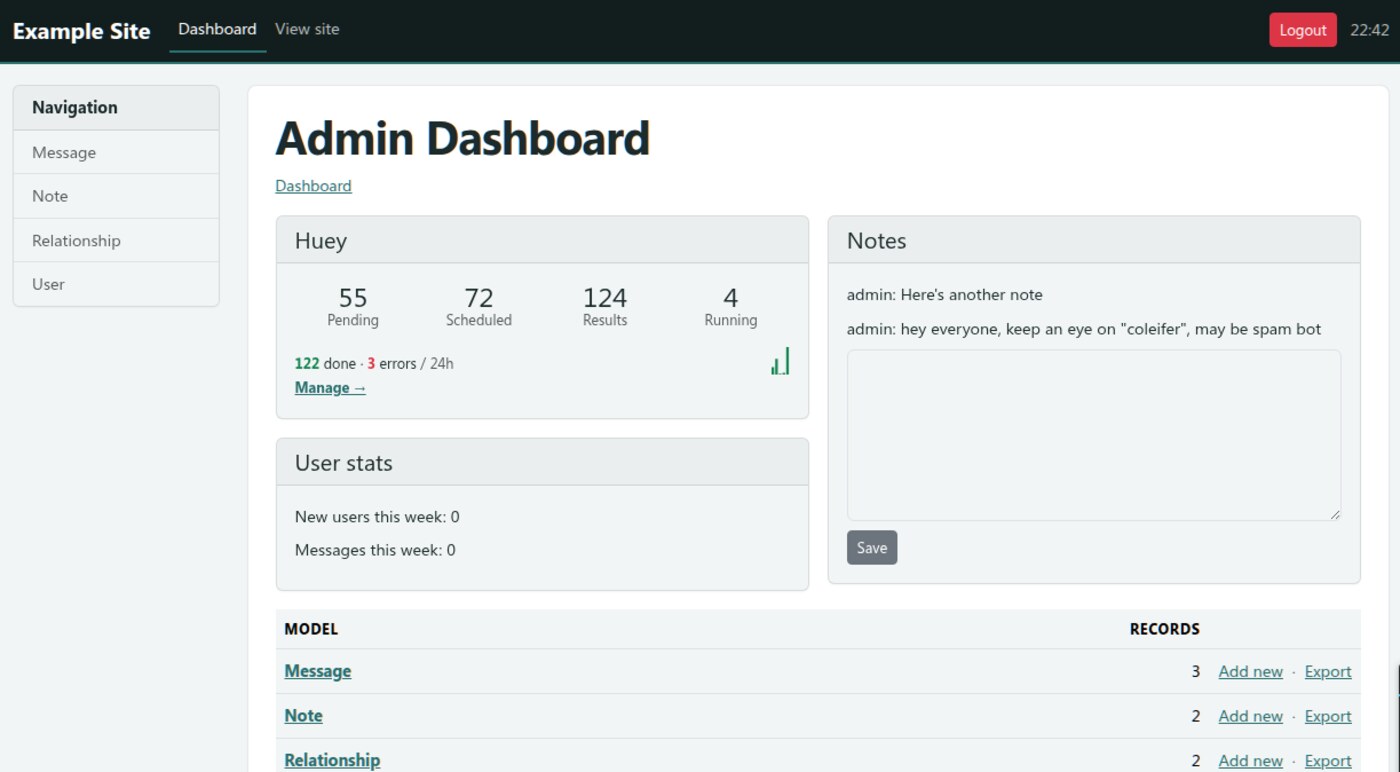
The operational ace is visibility. Huey ships a Django admin integration and a Flask admin panel that surface task statistics — pending, scheduled, executed, errored — without you writing a dashboard. For a small team, “I can see what the queue is doing from the admin site I already log into” is worth more than raw throughput.
Choose Huey if: you want minimal surface area, you like synchronous Python, and you would rather debug a queue inside your existing admin than stand up a monitoring stack.
Taskiq — Async-Native With Dependency Injection
Taskiq asks you to accept two premises: your code is async, and your queue should be a real message broker. In exchange you get async def tasks that behave like ordinary coroutines, PEP-612 typing for autocomplete, and an integration layer that lets tasks reuse the same dependencies your FastAPI routes use.
| |
A broker instance is the entry point. The broker you import determines the transport:

| |
Tasks are decorated coroutines, and .kiq() is how you enqueue:
| |
Workers start from a module path, and module discovery means you do not have to enumerate task files by hand:
| |
The --fs-discover flag imports every tasks.py in the current directory tree, and --reload gives you hot reloading during development (pip install taskiq[reload]).
The reason to choose Taskiq over Huey is not the API — it is that the dependency injection model lets a task depend on the same database session, config object, or authenticated context that an HTTP handler uses. Instead of a task function that reconstructs application state, it receives it. If you have ever written the phrase “we pass IDs around and re-fetch everything inside the worker,” Taskiq is aimed directly at that pain.
Choose Taskiq if: your service is async end to end, you already operate a message broker (or want one), and task-to-application dependency sharing matters to you.
Procrastinate — PostgreSQL Is the Queue
Procrastinate makes the narrowest promise of the three and keeps it well. Task definitions, locks, and dispatch are stored in PostgreSQL 13+, so your queue inherits the transactional guarantees of the database your data already depends on. There is no broker to run and no second consistency model to reason about.
| |
The async path uses coroutine tasks and the same app object:
| |
Administration happens through the same CLI, which means your deployment tooling can enqueue and run work without importing application code directly:
| |
The genuinely distinctive feature is transactional deferral. Because jobs live in Postgres, you can enqueue a job in the same transaction that writes the row which makes that job necessary. Either both commit or neither does. With a broker-backed queue you get an at-least-once pattern and a window where the write succeeded but the enqueue vanished. For financial, billing, or event-sourcing workloads, that guarantee alone justifies the choice.
Choose Procrastinate if: you are Postgres-centric, you value transactional dispatch, and you would rather tune a database than operate a broker.
Common Pitfalls and Migration Traps
Concurrency model mismatch is the number one mistake. Huey’s default consumer is a single thread. Teams migrate from Celery, see a dramatic throughput drop, and blame the library — when the fix is -k process -w 4 or -k greenlet -w 32. Match the execution model to the workload before you judge performance.
Idempotency is still your job. None of these libraries gives you exactly-once execution. Every one of them is at-least-once. If a task sends an email or charges a card, you need a deduplication key, and in Procrastinate’s case the task lock is the cleanest tool for it.
Do not put large payloads in the queue. Serialized arguments live in your broker or database. Pass an identifier and fetch the data inside the worker; otherwise your Redis memory or Postgres table becomes the real bottleneck.
Watch result storage growth. Result backends accumulate rows. Configure expiry on day one rather than discovering a 40 GB results table six months later.
Migrating off Celery is a rewrite, not a config change. Task decorators, signatures, chord and chain semantics, and the beat scheduler all differ. Port one critical queue first, run it in parallel, and compare behaviour before moving the rest.
Greenlets and native extensions do not always mix. Huey’s greenlet worker is extremely efficient for IO-bound work, but C extension code that blocks without releasing the GIL will stall the loop. Use process workers for that class of task.
FAQ
Is Huey fast enough to replace Celery for a medium-sized application? For the large majority of applications, yes. Huey with a process or greenlet worker handles thousands of tasks per minute comfortably on a single node, and most teams never approach that ceiling. Celery’s advantage appears when you need very high throughput, complex routing across many queues, or an ecosystem of broker-specific features.
Can I use these queues without Redis? Yes for Huey, which supports PostgreSQL, SQLite, filesystem, and in-memory storage with zero required dependencies, and yes for Procrastinate, which is PostgreSQL-only by design. Taskiq needs a real broker — NATS, Redis, RabbitMQ, or Kafka — so it is the weakest fit if you are trying to avoid new infrastructure.
Which one is best for Django projects? Huey, without much debate. It ships native Django integration plus an admin view that exposes task statistics and lets you manage the queue from the interface your operators already use. Procrastinate also has Django support, so it is a reasonable second choice if your stack is firmly Postgres-first.
Do these libraries support periodic or scheduled tasks?
All three do. Huey uses a crontab object on a periodic_task decorator, Taskiq provides a scheduler companion, and Procrastinate supports periodic jobs. If you are running a lot of cron-style work, read our task queue monitoring dashboard comparison — observability is usually the harder problem than scheduling itself.
How do these compare to Celery, Dramatiq, and ARQ? Celery trades simplicity for ecosystem breadth, Dramatiq optimises for reliability with a smaller API, and ARQ is the minimal async option. We covered that trio in depth in our Celery vs Dramatiq vs ARQ comparison. The group here is the tier below: less machinery, fewer moving parts, and in Huey’s case zero dependencies at all.
What about sharing database sessions or config between web handlers and tasks? This is where Taskiq stands apart. Its dependency-injection integration lets workers resolve the same dependencies your web framework uses, so you are not rebuilding application state inside every job. If your tasks currently take an ID, re-query the database, and reconstruct context, that redundancy is a sign you want Taskiq — or a lighter dependency-injection approach along the lines of our Python dependency-injection library comparison.
💰 想测试你的市场判断力?我用 Polymarket 做预测市场交易——这是全球最大的预测市场平台,从大选结果到技术监管时间线,什么都可以押注。和赌博不同,这是真正的信息市场:你懂的信息越多,胜率越高。我靠预测技术相关事件的走向已经赚了不少。用我的邀请链接注册:Polymarket.com