Every sensor pipeline starts the same way: you plot the raw readings, see noise, and add a Kalman filter. Then you discover the hard part is not the theory — it is that the four mature open-source implementations make completely different trade-offs, and one of them allocates memory with malloc in a control loop while another simply has no floating-point precision option for your microcontroller.
This is a practical comparison of the state-estimation libraries that are actually maintained in 2026, with the API each one really exposes and the situations where each one wins.
TL;DR — Quick Verdict
Use filterpy if you are prototyping in Python and want the widest menu of estimators — linear Kalman, extended, unscented, particle, g-h, least squares, H-infinity and smoothers — in one NumPy library. Use pykalman if you need expectation-maximization to learn the noise covariances and transition matrices from data instead of guessing them. Use TinyEKF if you are deploying to a microcontroller or an embedded target where compile-time memory allocation and a single header are non-negotiable. Use mherb/kalman if you are writing modern C++ and want typed, Eigen-based EKF/UKF variants with square-root formulations for numerical stability.
Rule of thumb: Python work → filterpy or pykalman (learning). Embedded or C++ work → TinyEKF or mherb/kalman.
Quick Comparison Table (October 2026)
| Library | Stars | Language | Estimators | Parameter learning | Allocation | License | Last push |
|---|---|---|---|---|---|---|---|
| filterpy | 3,882 | Python (NumPy) | KF, EKF, UKF, particle, g-h, least squares, H-infinity, smoothers | Manual tuning | NumPy arrays (heap) | MIT | 2024-02-07 |
| pykalman | 1,338 | Python (NumPy) | KF, smoother, EM | Yes — em() | NumPy arrays (heap) | New BSD | 2026-04-20 |
| TinyEKF | 1,222 | C / C++ header | EKF | Manual tuning | Static (compile-time) | MIT | 2026-04-09 |
| mherb/kalman | 1,502 | C++11 header (Eigen) | EKF, SR-EKF, UKF, SR-UKF | Manual tuning | Eigen fixed/dynamic | MIT | 2023-08-24 |
The staleness pattern here is worth noticing: filterpy has the most stars and the oldest last push, because it is feature-complete and stable. mherb/kalman is similarly dormant (2023) without being abandoned — header-only C++ libraries that work tend not to churn. The two actively developed projects, pykalman and TinyEKF, both had pushes in 2026.
Decision Matrix: Pick in 10 Seconds
| Your situation | Pick | Why |
|---|---|---|
| Prototyping on a laptop, comparing estimator families | filterpy | Widest estimator menu, best-documented examples |
| You don’t know Q and R and have offline data | pykalman | EM learns noise covariances and matrices |
| Arduino / STM32 / no dynamic allocation allowed | TinyEKF | Static arrays, single header, float or double |
| Modern C++ with Eigen, typed state and measurement models | mherb/kalman | Compile-time model typing, SR variants |
| Non-linear measurement, need UKF on a PC | filterpy or mherb/kalman | Both ship unscented implementations |
| You need a particle filter | filterpy | Only one of the four with a particle implementation |
| You need a smoother (offline, whole-trajectory) | pykalman or filterpy | RTS smoother available in both |
filterpy: The Learning and Prototyping Workbench
filterpy (3,882 stars, MIT) is the library behind the widely used Kalman and Bayesian Filters in Python course material. If you have read a Kalman filter tutorial with Python code in the last decade, it was probably filterpy.
| |
| |
Two things make filterpy the right default for exploration. First, Q_discrete_white_noise builds physically meaningful process noise from a sampling interval and variance, which removes one of the most common sources of badly tuned filters. Second, the uniform predict() / update() interface means you can swap in ExtendedKalmanFilter, UnscentedKalmanFilter, ParticleFilter or a smoother class without rewriting the surrounding pipeline.
The trade-off is maintenance tempo: the last push predates 2025, so treat it as a stable reference implementation rather than a project expecting new features.
pykalman: Learn the Noise Model Instead of Guessing It
pykalman (1,338 stars, New BSD, active in 2026) solves the single most annoying practical problem in state estimation: you rarely know Q and R a priori, and hand-tuning them is a weekend. pykalman exposes em() — expectation-maximization — to fit the transition matrices, observation matrices and noise covariances from measurement data.
| |
| |
The workflow this enables is genuinely different from filterpy’s: collect data, run em() to fit the noise model, inspect the learned covariances, then decide whether they match your physical intuition. If the learned Q says your sensor drifts 10x faster than the datasheet claims, you have found a real bug rather than tuned around it.
Be deliberate about n_iter: EM is an iterative optimizer over a non-convex objective, and more iterations is not automatically better. Five to twenty is the usual range before convergence, and you should always confirm with a held-out trajectory rather than the training data.
TinyEKF: Embedded Deployment Without Surprises
TinyEKF (1,222 stars, MIT, active in 2026) exists because general-purpose matrix libraries are a poor fit for a 32-bit microcontroller. It is a single header using static, compile-time memory allocation — no new, no malloc — and its matrix dimensions are preprocessor macros resolved at compile time.
The trade-off is explicit in the API: you define EKF_N (state dimension) and EKF_M (measurement dimension) before including the header, and the whole library instantiates for exactly those sizes.
| |
That failed-update branch is not decoration. ekf_update() returns false when the Cholesky factorization of the innovation covariance fails, which happens in the real world when a sensor drops out or reports NaN. Embedded code that ignores the return value will happily propagate garbage.
Two more embedded-specific notes: define _float_t to double before including the header if single precision is not enough (TinyEKF supports both), and remember that with static allocation you cannot run two differently-sized filters in one translation unit — put each in its own compilation unit.
For the sensing layer that usually feeds a filter like this, our point cloud processing comparison covers the heavier 3D side of the same problem.
mherb/kalman: Typed Models in Modern C++
mherb/kalman (1,502 stars, MIT, header-only C++11) takes the opposite approach to TinyEKF: instead of macro-sized arrays, you define your state, control and measurement types at compile time as C++ classes, and the filter is templated on them. It ships four variants — EKF, square-root EKF, UKF, and square-root UKF — built on Eigen.
| |
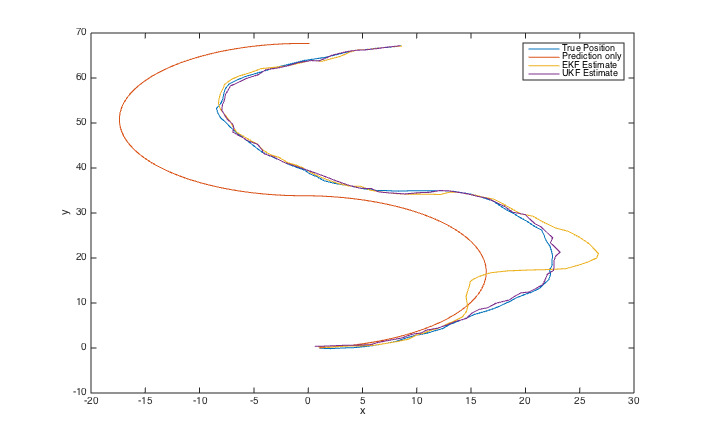
The reason to prefer this over a hand-rolled filter is the type system doing work for you: a position measurement cannot be accidentally passed to the orientation model, and the Jacobians each model class must provide are checked at compile time. The repository ships a fully commented examples/Robot1 project that implements a robot localizing against two landmarks — read that file before writing your own models, because it demonstrates the exact set of functions (f, F, h, H) each model class has to implement.
If you are building the surrounding stack rather than the filter itself, our roundups of self-hosted robotics simulation tools and the open autopilot stack comparison show where these estimators sit in a real pipeline.
Note the activity date: the last push was 2023. That is normal for a complete header library, but it does mean you should vendor a pinned copy rather than depend on the moving master branch in a production build.
Numerical Pitfalls and Tuning Notes That Save Weekends
1. Covariance symmetry drift. Repeated P = (I − K H) P updates accumulate asymmetry and can eventually produce negative diagonals. Use the Joseph form (P = (I−KH)P(I−KH)' + KRK') or a square-root variant (mherb’s SR-EKF/SR-UKF, or a Cholesky-based implementation) when running millions of updates.
2. Angle wrap-around. Any state containing an angle needs normalized innovation: wrap the residual into (−π, π] before the update. Skipping this produces a filter that looks fine for small errors and then jumps violently near the ±π boundary.
3. Q and R are not “small is better.” Too-small R makes the filter trust a noisy sensor and track noise; too-small Q makes it ignore real motion and lag. If you have data, let pykalman’s em() propose values and validate physically; if you do not, express Q in physical units via something like Q_discrete_white_noise.
4. Single precision in embedded targets. A 32-bit float has about 7 decimal digits. Filters with large covariance magnitudes (1e6) and small measurement noise (1e-4) lose all significance — that is exactly when you set _float_t to double in TinyEKF, or rescale your units (work in meters rather than millimeters).
5. Ignoring the update return value. As noted above, ekf_update() returning false means the covariance matrix was not factorizable. Handle it: skip the measurement, count the rejections, and raise a diagnostic when rejections cluster.
6. Divergence detection. Track the normalized innovation squared (NIS) — the residual normalized by the innovation covariance — and compare its running average against the expected chi-square value for your measurement dimension. A filter that has quietly diverged shows up as NIS growing monotonically long before the estimate looks obviously wrong.
7. Out-of-sequence measurements. Multi-sensor systems delivering readings with different latencies cannot just call update() in arrival order. Buffer by timestamp and either process in order or implement a retrodiction step; silently reordering measurements is a classic source of position jumps in robotics.
Which One Should You Actually Use?
Start in filterpy to build intuition and compare estimator families on recorded data, because the uniform API and the accompanying course material make iteration cheap. As soon as you have a dataset and no defensible Q/R, move to pykalman and learn them with em() — then sanity-check the learned covariances against your sensor datasheets. When the algorithm has to leave the laptop, choose by target: TinyEKF for microcontrollers and static-allocation constraints, mherb/kalman for C++ projects where Eigen and compile-time model typing are available.
Whatever the deployment target, the test that keeps you honest is the same: replay a recorded trajectory where you know the ground truth, and assert that the filtered estimate beats the raw measurement in RMS error. A filter that loses to its own input is a bug, not a tuning problem.
FAQ
Which Kalman filter library is best for Python in 2026?
filterpy for breadth — it covers linear, extended, unscented and particle filters plus smoothers in a uniform API. pykalman when you need to learn noise covariances and transition matrices from data using expectation-maximization. Many teams use filterpy for prototyping and pykalman to fit the parameters.
What is the difference between an extended and an unscented Kalman filter?
The extended Kalman filter linearizes a non-linear model around the current estimate using Jacobians — accurate for mild non-linearity, cheap per step. The unscented Kalman filter instead propagates a deterministic set of sigma points through the true non-linear function, which usually gives better accuracy for strongly non-linear measurement models at a higher per-step cost. filterpy and mherb/kalman both provide both.
Can I run a Kalman filter on a microcontroller?
Yes — that is exactly what TinyEKF is built for. It uses compile-time static allocation (no malloc), so memory use is fully predictable, and it runs on Arduino, Teensy and STM32 class hardware. You choose single or double precision by defining _float_t before including the header.
How do I choose the process noise Q and measurement noise R?
If you have recorded data, use pykalman’s em() to fit them, then check whether the learned values are physically plausible. Without data, derive Q from the sampling interval and expected accelerations or drifts — filterpy’s Q_discrete_white_noise(dim, dt, var) does this for common motion models — and derive R from your sensor datasheet variance. Then validate with a NIS consistency check.
Does pykalman support smoothing, and what is it for?
Yes. kf.smooth(measurements) runs an RTS-style smoother that uses the entire trajectory to estimate each state, which is strictly more accurate than filtering for offline analysis — trajectory reconstruction, post-processing logged data, or generating training labels. It cannot be used in real time because it needs future measurements.
Why does my filter diverge even though the model is correct?
The usual causes, in order of frequency: an unhandled angle wrap-around in the innovation; a covariance matrix that lost symmetry and developed negative diagonal entries from repeated non-Joseph updates; R set far too small relative to actual sensor noise; and single-precision arithmetic on a problem whose covariance magnitudes span more orders of magnitude than a 32-bit float can represent. Log NIS and the covariance diagonal to identify which one you have.
💰 想测试你的市场判断力?我用 Polymarket 做预测市场交易——这是全球最大的预测市场平台,从大选结果到技术监管时间线,什么都可以押注。和赌博不同,这是真正的信息市场:你懂的信息越多,胜率越高。我靠预测技术相关事件的走向已经赚了不少。用我的邀请链接注册:Polymarket.com