Roughly half the world’s population has no social protection coverage at all, and the systems that do exist are frequently a spreadsheet taped to a decade-old database. When a ministry decides to modernise, the usual answer is a six-figure proprietary licence plus a consultant who owns the source code. That is exactly the problem the open-source G2P (“government-to-person”) ecosystem was built to solve — and in 2026 three very different projects are competing for that job: OpenSPP, OpenG2P and OpenFisca.
They are not interchangeable. One is an Odoo-based programme management suite, one is a Kubernetes-native digital public infrastructure (DPI) framework, and one is a rules-as-code calculation engine that computes entitlements rather than storing beneficiaries. Picking the wrong one costs you a rewrite.
TL;DR: Quick Verdict
- Choose OpenSPP if you need a working beneficiary registry, programme enrolment and payment-cycle management this quarter, and you are comfortable running Odoo. Fastest path from install to a usable UI.
- Choose OpenG2P if you are a ministry or large implementer with a Kubernetes platform team and a mandate to build national-scale DPI with strict separation between registries, consent and payments.
- Choose OpenFisca if your problem is rules, not records — eligibility formulas, tax-benefit simulation, “what happens to 40 million households if we change this threshold?” — and you want to version those rules like code.
- The pragmatic combo: OpenSPP or OpenG2P for the registry of record, OpenFisca for the entitlement calculation layer. Teams that understand this split ship faster.
The Comparison Table (data pulled from GitHub, October 2026)
| Dimension | OpenSPP | OpenG2P | OpenFisca |
|---|---|---|---|
| Primary repo | OpenSPP/openspp-modules — 38 stars (pushed 2026-08-31) | OpenG2P/openg2p-registry — 9 stars (pushed 2026-06-17) | openfisca/openfisca-core — 242 stars (pushed 2026-10-08) |
| Companion repo | OpenSPP/openspp-docker — 25 stars | OpenG2P/openg2p-deployment — updated 2026-10-08 | openfisca/openfisca-france — 314 stars |
| Language | Python (Odoo modules) | Python | Python + NumPy |
| Licence | LGPL-3.0-or-later | MPL-2.0 | AGPL-3.0 |
| Deployment model | Docker Compose (Doodba-style) | Kubernetes / Rancher | pip package + openfisca serve (gunicorn) |
| Core abstraction | Beneficiary + programme records | Registries, consent, payments as services | Variables, parameters, reforms |
| Best fit | NGOs, pilot programmes, district deployments | National DPI, multi-ministry programmes | Policy simulation, entitlement engines |
| Time to first UI | Hours | Days to weeks | N/A (API/library) |
Decision Matrix: Use Case → Tool
| Your situation | Use | Why |
|---|---|---|
| Cash transfer pilot for 5,000 households, no platform team | OpenSPP | Ships registries, enrolment workflows and a full admin UI out of the box |
| National ID-linked social registry with multiple integrating agencies | OpenG2P | Service-oriented, Kubernetes-native, designed for institutional separation |
| “Model the cost of raising the child grant by 15%” | OpenFisca | Purpose-built microsimulation over legislation, not a database |
| You must reproduce a benefit decision three years later for an audit | OpenFisca + registry | Rules are versioned artefacts in Git |
| Village-level data collection with offline officers | OpenSPP | Odoo mobile-capable forms plus a mature permissions model |
| Multi-country rollout under one governance umbrella | OpenG2P | Designed as reusable building blocks rather than one monolith |
OpenSPP — The Pragmatic Programme Suite
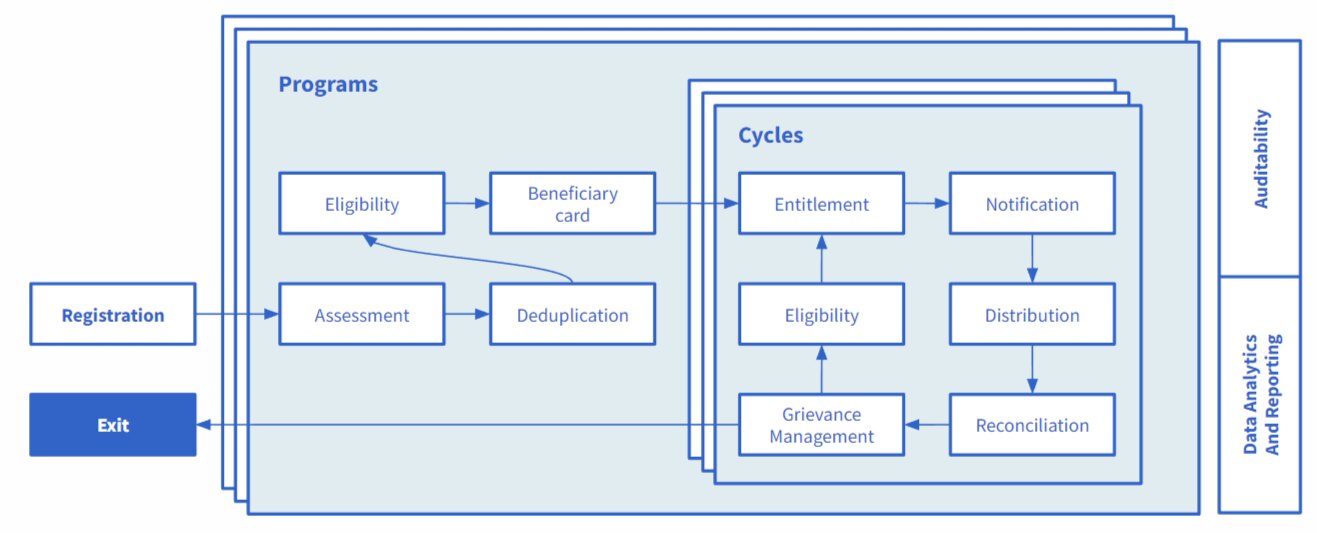
OpenSPP is the most usable of the three on day one, and that is not an accident: it is built on Odoo, so you inherit a mature web UI, role-based access control, reporting and a huge module ecosystem. The project licenses its own code under LGPL-3.0-or-later, which matters if you plan to write proprietary extensions on top — you can, as long as your changes to OpenSPP itself stay open.
The practical reality check: the official Docker repository literally opens with “This is experimental and not ready for production use.” Treat that as a serious instruction, not boilerplate. The Docker setup is built on Doodba (a well-known Odoo deployment pattern) driven by invoke tasks:
| |
The default development stack exposes Odoo at http://localhost:${ODOO_MAJOR}069 and runs a bundled MailHog SMTP relay that intercepts every outgoing message — genuinely useful when you are debugging the notification flow of an enrolment workflow without spamming real beneficiaries. The Docker network runs in --internal mode by default, so a restored production database cannot silently dial home to third-party mail or API endpoints; if you need egress you flip internal: false deliberately.
Two OpenSPP details that matter in the field: the API surface is documented with a live OpenAPI/Swagger console (the screenshot below), which is what most integrators end up using to feed an existing national registry, and the modules ship as ordinary Odoo addons — meaning your team can extend them with normal Python instead of learning a bespoke plugin format.
Where OpenSPP bites: the Odoo coupling is both its superpower and its constraint. Version upgrades are Odoo upgrades, customisations live in addon directories that must be re-aggregated on every deploy, and the invoke-based workflow expects operators who read documentation carefully. Budget real time for the first production hardening.
OpenG2P — Infrastructure-Grade DPI
OpenG2P is aimed at a different buyer: a ministry or a national programme with a platform team. It is licensed MPL-2.0 (file-level copyleft — friendlier for integrators than the GPL family) and it deliberately refuses to be a single monolith. Instead you assemble registries, consent management and payment connectors as separate services.
Deployment is Kubernetes-first. The official openg2p-deployment repository is explicit about its three automation tracks:
| |
Note the deliberate governance quirk documented in the repository README: production scaffolding does not install the shared “Commons” components — you install those from the Rancher UI only, after the environment stage completes. That is a design choice about who holds cluster-admin privileges, and it tells you a lot about the intended operator maturity. Without a Kubernetes cluster, a container registry and someone who understands namespaces and ingress, OpenG2P will stall at the evaluation stage.
The upside of that strictness: the same building blocks can back a social registry, a farmer registry and a benefit-payment bridge without each programme inventing its own integration. If your ambition is national scale and you already run Rancher, this is the architecture that scales with you.
OpenFisca — Rules as Code, Not a Registry
OpenFisca does not store beneficiaries and does not want to. It is a microsimulation engine: you describe a tax-benefit system as Python variables and parameters, then ask it what any household is entitled to under any date’s legislation. The core engine is AGPL-3.0, and country packages (openfisca-france alone has 314 stars) carry the actual legal content.
Installation is standard Python tooling, and newer documentation drives it through uv:
| |
Serving your own instance is a single command — the built-in server wraps gunicorn, so anything you already know about gunicorn applies:
| |
There is also a public instance you can query before you deploy anything — useful for a 30-minute feasibility check. The documented endpoints expose parameters, variables and full calculations, for example the hourly minimum-wage parameter and the base family-allowance variable:
| |
Bootstrapping a new country package is a documented sprint rather than a research project — the project ships a country-template repository precisely so a new jurisdiction starts from a working skeleton. That is rare and valuable: most entitlement software makes your country the edge case.
The trap: teams regularly buy OpenFisca expecting a beneficiary management system. It has no case management, no document workflow, no payment reconciliation. It answers “how much?” with auditable, versioned logic — nothing more. Pair it with a registry.
Avoiding the Classic Integration Mistakes
- Do not put beneficiary PII into Git. OpenFisca models are code and belong in version control. Registries are not. Keep the two lifecycles separate or your first audit will be painful.
- Do not treat the OpenSPP Docker repository as production-ready. The maintainers say it is experimental. Start there, then harden: pinned image digests, external managed PostgreSQL, backups, and a real reverse proxy.
- Do not underestimate Odoo version coupling. OpenSPP tracks specific Odoo major versions. Pick your OpenSPP version and your Odoo upgrade calendar together, or you will be maintaining two divergent forks.
- Do not deploy OpenG2P without cluster ownership. If your Kubernetes cluster is rented from a vendor that controls ingress and storage classes, you cannot complete the Rancher-based Commons installation cleanly.
- Licence hygiene matters at scale. LGPL (OpenSPP) lets you ship proprietary modules around the core; AGPL (OpenFisca) effectively obliges you to publish modifications when you expose the software over a network. Get legal sign-off before the pilot, not after.
FAQ
Is OpenSPP production-ready? The module code is mature and actively maintained, but the official Docker deployment repository describes itself as experimental and not ready for production. Plan for a hardening phase: managed PostgreSQL, pinned images, monitoring and a proper reverse proxy before you handle real beneficiary data.
Can OpenFisca replace a social registry? No. OpenFisca computes entitlements from rules and household situations. It stores no beneficiaries, no enrolment history and no payment records. Use it alongside a registry such as OpenSPP or OpenG2P.
Does OpenG2P require Kubernetes? In practice, yes. The deployment automation targets Kubernetes and its production track assumes a three-node topology with namespaces, gateways and Rancher-managed components. The sandbox track exists for single-VM proofs of concept, but production without a cluster is not a supported path.
Which project has the most permissive licence for commercial integrators? OpenG2P (MPL-2.0) and OpenSPP (LGPL-3.0) are both workable for commercial integration — MPL is file-level copyleft, LGPL permits proprietary modules alongside the licensed core. OpenFisca is AGPL-3.0, which is the strictest of the three for network-exposed deployments.
How much hardware do I need to evaluate these? OpenSPP needs a modest VM — a couple of CPU cores and 4-8 GB of RAM runs the development stack comfortably. OpenG2P’s sandbox track fits on a single VM, but its production topology assumes dedicated nodes. OpenFisca needs almost nothing: it is a Python package, and you can start with the public API before installing anything.
Can these coexist in one programme? Yes, and this is the recommended architecture: a registry of record (OpenSPP or OpenG2P) for identities and enrolment, plus OpenFisca to compute entitlement amounts from versioned legislation. Keep a clean interface between them so either side can be replaced.
Why Self-Host Social Protection Infrastructure?
Beneficiary data is the most sensitive category of personal information any institution holds: identity documents, addresses, disability status, income, sometimes biometrics. Sending it to a third-party SaaS platform means your programme’s legal exposure is governed by someone else’s terms of service, infrastructure and jurisdiction — and for many public-sector programmes that is simply not permissible.
Self-hosting also buys you the two things social protection systems actually need at scale: auditability and permanence. When entitlement rules live in version control and decisions are reproducible, you can answer an ombudsman’s question about a payment made three years ago. When the registry runs on your infrastructure, a vendor pivot or price increase cannot strand forty million beneficiaries mid-payment-cycle.
And the cost argument is real. Programmes that move off per-beneficiary proprietary licensing often redirect the licence savings into field operations and grievance-handling — the parts of delivery that actually determine whether people get paid. If you are assembling a wider open-source public-sector stack, our comparison of citizen participation platforms covers the governance layer, our health information systems comparison covers the health registry analogue, and our document automation guide covers the forms and letters layer that sits on top of any of these registries.
The Verdict
For 2026, the honest answer is that these three tools solve three different layers of the same problem. OpenSPP wins on time-to-value — you can show a working beneficiary registry in a day, and the Swagger API gets you integrated with legacy systems quickly. OpenG2P wins on institutional architecture — it is the only one designed from the ground up for multiple agencies and national scale, and its MPL-2.0 licence is the friendliest for integrators. OpenFisca wins on correctness and auditability — rules as versioned code is the only approach that survives a policy change and a public audit.
Start with OpenSPP to get a real registry in front of real users, introduce OpenFisca the moment entitlement rules become contested, and graduate to OpenG2P when your programme outgrows a single ministry.
💰 想测试你的市场判断力?我用 Polymarket 做预测市场交易——这是全球最大的预测市场平台,从大选结果到技术监管时间线,什么都可以押注。和赌博不同,这是真正的信息市场:你懂的信息越多,胜率越高。我靠预测技术相关事件的走向已经赚了不少。用我的邀请链接注册:Polymarket.com