Rebol had the pitch that functional-programming Twitter rediscovered last week: one ~1MB binary, no install, no config, no package manager, a full standard library and a REPL, and a parsing system that lets you define your own syntax inside a normal function. That pitch is from 1997. In 2026 the original repository has been silent since 2024-08-09 — but three descendants are still pushing commits, and they disagree about almost everything.
Here is the family tree as it actually stands, with live repository data and code you can paste into a terminal today.
TL;DR — Quick Verdict
- You want a single-file tool that builds a real GUI window and a standalone binary → Red (6,042★). It is the only member of the family with a cross-platform GUI system, a drawing dialect and a native-code compiler in one download.
- You want to write scripts today with a one-line installer → Arturo (887★).
curl -sSL https://get.arturo-lang.io | shand you are running; no reserved words anywhere in the language. - You are embedding a Rebol-dialect interpreter into an existing C codebase → Ren-C (142★). That is literally its stated purpose, and it is the only member of the family designed as an embeddable library first.
- You want the original Rebol → the source is Apache-2.0 at
rebol/rebol, but treat it as archaeology, not a foundation. Two of the three descendants exist precisely because that lineage stalled.
The Family at a Glance
| Project | Stars | License | Latest release | Last repo activity | Implementation |
|---|---|---|---|---|---|
Red (red/red) | 6,042 | BSL-1.0 | v0.6.6 (2025-03-19) | 2026-09-20 | Self-hosted, bootstrapped from Rebol |
Arturo (arturo-lang/arturo) | 887 | MIT | Nightly builds + tagged releases | 2026-09-10 | Written in Nim |
Rebol 3 (rebol/rebol) | 891 | Apache-2.0 | Legacy | 2024-08-09 | Original C interpreter |
Ren-C (metaeducation/ren-c) | 142 | LGPL-3.0 | Rolling | 2026-07-16 | Fork of the Rebol 3 C codebase |
All figures were read from GitHub on 2026-09-24. The gap between Red’s 6,042 stars and Ren-C’s 142 is not a rounding error — it is the difference between a project with an active release process and a research codebase that happens to be public.
Decision Matrix: Pick by Job, Not by Nostalgia
| Your job | Pick | Why |
|---|---|---|
| Desktop tool with a real window, shipped as one binary | Red | GUI system plus drawing dialect plus redc compiler |
| Rapid scripting, glue code, text processing | Arturo | Modern installer, clean error messages, no keyword list to memorise |
| Embed a dialect interpreter in a C program | Ren-C | Library-first design with a documented C API |
| Parse a custom format without writing a parser | Red | The parse DSL is the family’s crown jewel |
| Build a modern web service | None of these | Use a mainstream runtime — these are single-binary and desktop languages |
| A syntax-driven CLI you can compile anywhere | Arturo | Pre-built binaries for essentially every OS |
Red — The Only One With a GUI Story
Red’s own description is refreshingly specific: “a next-generation programming language strongly inspired by Rebol, but with a broader field of usage thanks to its native-code compiler, from system programming to high-level scripting and cross-platform reactive GUI, while providing modern support for concurrency, all in a zero-install, zero-config, single ~1MB file.”
Two dialects do the heavy lifting. Red/System is the low-level, C-like layer that the compiler targets. Red/View is the GUI dialect, and it is astonishingly compact. Straight from the official README, here is a working GUI hello world:
| |
That is the entire program. Here is the README’s more ambitious example, which fetches this very repository’s commit log over HTTPS and renders it as a scrollable list:
| |
Read that again: an HTTP request, a foreach over parsed JSON-ish data, and a GUI widget tree, with no imports, no manifest and no async ceremony. That density is the entire reason people still care about this language.
Compiling to a standalone executable is the same download — the toolchain is a single file you rename to redc:
| |
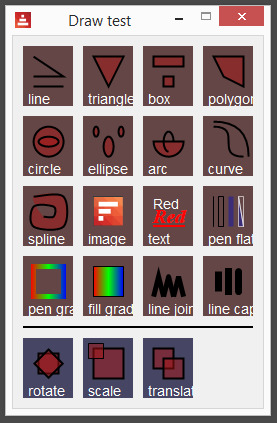
The caveat that matters most: the README states the standalone compiler ships for the big three platforms and is 32-bit only for now. If you need a 64-bit native executable from Red, verify the current state of the toolchain before you commit to it.
Verdict: the pragmatic choice. Red is the only member of this family that can plausibly replace a small desktop application, and it has the stars and the release discipline to back that up.
Arturo — The Modern Reboot, Written in Nim
Arturo takes Rebol’s core insight — code is just a list of words, symbols and literal values — and rebuilds it as an independently developed language with an explicit lineage: Logo, Rebol, Forth, Ruby, Haskell, D, Smalltalk, Tcl and Lisp.
The README makes a claim that sounds like marketing until you use it: there are no reserved words and no keywords at all. Words inside a block are interpreted according to context when needed, which is how the same syntax can express arithmetic, a loop and a function call.
Here is the official factorial example from the repository README:
| |
Installation is the cleanest in the family — a pre-built binary for essentially every OS, or one line in your shell:
| |
Arturo is also the only member of the family with a first-class container story, which makes it usable in CI today:
| |
The broader project is worth a look as well: Grafito (a portable, serverless SQLite-based graph database) and Aguila (desktop apps built on a webview without HTML, CSS or JavaScript) are both Arturo programs, which is the strongest evidence that the language can carry a real application rather than only a demo.
Verdict: the best choice if you are starting today. Modern install, MIT license, active commits, and a language design that is genuinely easier to teach than Rebol’s original corpus of undocumented dialects.
Ren-C — 142 Stars and a Genuinely Clever C API
Ren-C is not trying to be a language you write applications in. Its repository description says it plainly: a library for embedding a Rebol interpreter into C codebases. It continues the Rebol 3 codebase and extends platform coverage well beyond what Rebol 3 ever reached.
The interesting part is the API. Rather than forcing C programmers to build values by hand, Ren-C lets you splice C values into island-style dialect strings:
| |
That trick — composing code as a mixture of strings and spliced values so the interpreter sees one continuous stream — is what makes mixed C/Rebol code readable. It is also, unfortunately, the reason the project is hard to learn from a distance: the sophistication is aimed at interpreter implementers, not at app developers.
Verdict: if you maintain a C program that needs a scripting layer with an unusually flexible grammar, Ren-C is the serious option in this space. If you just want to write scripts, you will spend a weekend reading implementation notes and get less done than you would in Arturo.
Rebol Itself — Excellent History, Poor Starting Point
rebol/rebol holds the Rebol 3 source under Apache-2.0: 891 stars, and no commits since 2024-08-09. Rebol 2 was distributed as closed-source freeware, which is why the family forks exist at all — one lineage could not be legally (or practically) evolved by the community, so Rebol 3, then Ren-C, then Arturo each took a different route forward.
If you are evaluating this family in 2026, the original should be a reference point and a parser-combinator idea source, not a runtime for new work.
Why Dialects Still Matter in 2026
The reason to look at this family at all is not nostalgia — it is the dialect model of programming. In a language with no fixed grammar, parse is not a library, it is a way to define a syntax for your own data and then run it. Where a mainstream stack reaches for a YAML file plus a schema validator plus a plugin registry, a dialect language writes the grammar inline and treats the document as code.
That idea is alive elsewhere, and the comparisons are worth reading side by side:
- The Lisp side of the same instinct, where the program is the data structure — see our Janet vs Fennel vs Hy comparison.
- The stack-based version, where the syntax is a sequence of tokens you define — see Forth implementations compared.
- The grammar-heavy mainstream version, in Racket, Chez and Guile — the language family that made custom syntax a first-class feature decades before anyone called it a dialect.
Pitfalls: What the Documentation Buries
Red’s toolchain is 32-bit only for now. The README says it plainly. Confirm before you plan a 64-bit deployment, and do not assume a blog post from 2019 reflects the current state.
Red’s compiler bootstraps through Rebol. The build instructions for running from source begin with installing the Rebol-based compiler toolchain. That is elegant and unusual, and it also means toolchain debugging occasionally sends you into a second language.
The GUI console has a Wine quirk. The README documents that the GUI console has issues under Wine and recommends installing the Consolas font to fix it — a small thing that will cost you an hour if you find it in the wrong order.
Ren-C’s license is LGPL-3.0, not MIT. If you are embedding an interpreter into a proprietary product, that is a materially different conversation from Red (BSL-1.0) or Arturo (MIT). Check it before you design around it.
Ecosystem depth is the real risk, not language quality. Arturo has a package-hub structure but nothing resembling npm or PyPI for breadth. Every non-trivial project in this family is partly a research project. Budget for reading source code, not for finding a library.
Dialect code is hard to read for newcomers. The density that makes view [text "Hello World!"] charming also means a 200-line Red script contains no familiar structural signposts. Onboarding a second developer costs more here than in almost any mainstream language.
FAQ
Is Red the same language as Rebol? No. Red is strongly inspired by Rebol and shares the syntax feel, the dialect approach and even a self-hosting story, but it is a separate implementation with its own compiler, its own Red/System low-level dialect and its own standard library. It was designed to go beyond Rebol into native compilation and cross-platform GUI work.
What is the most actively maintained Rebol-family language in 2026?
By repository activity, Red: 6,042 stars with commits on 2026-09-20 and a tagged release (v0.6.6). Arturo is also active (2026-09-10, 887 stars) and Ren-C saw activity on 2026-07-16. The original rebol/rebol repository has been dormant since 2024-08-09.
Can I run Arturo in a container without installing anything?
Yes. docker run -it arturolang/arturo starts an interactive session from the official image, and docker run -it -v $(pwd):/home arturolang/arturo yourscript.art runs a local script with the current directory mounted.
Why would I embed an interpreter instead of writing a plugin system?
Because a dialect interpreter lets your users define grammar, not just parameter values. Ren-C’s rebElide API is built exactly for that: you keep the host application in C and let a scripting layer express shapes of data the host never anticipated.
Does the 1MB single-binary claim still hold? For Red, the README states the single-file download contains the whole toolchain, the full standard library and a REPL, with a note that it is temporarily split into two binaries. That constraint — one file, no installer, no dependency tree — is the family’s original selling point and still its clearest differentiator from every other scripting runtime.
💰 想测试你的市场判断力?我用 Polymarket 做预测市场交易——这是全球最大的预测市场平台,从大选结果到技术监管时间线,什么都可以押注。和赌博不同,这是真正的信息市场:你懂的信息越多,胜率越高。我靠预测技术相关事件的走向已经赚了不少。用我的邀请链接注册:Polymarket.com