The weakest link in most embedded teams is not the compiler or the kernel — it is the physical board sitting on one engineer’s desk. One dev kit, one person flashing it, and a regression suite that only runs when somebody remembers to plug it in. Emulation fixes that, but the three obvious choices are not interchangeable: QEMU (13,753 GitHub stars) emulates fast enough to run a full Linux userspace, Renode (2,924 stars) models multi-node boards deterministically for CI, and gem5 (2,827 stars) trades speed for architectural fidelity you can publish papers about.
Picking the wrong one wastes weeks. This guide is written from the perspective of someone who wants a firmware pipeline that boots the image on every commit, not a research project.
TL;DR — Quick Verdict
- Pick Renode if your target is a microcontroller or multi-node embedded system, you want deterministic tests, and you need a headless CI job that starts in seconds.
- Pick QEMU if you are doing systems programming on ARM, RISC-V, x86 or s390x, need to boot a real Linux kernel plus userspace, or want hardware acceleration through KVM.
- Pick gem5 if you need cycle-level accuracy, memory-system detail, cache/Ruby interconnect modelling, or you are evaluating an architecture rather than shipping firmware.
Verdict up front: Renode for product firmware CI, QEMU for OS and kernel work, gem5 for architecture research. Many teams end up running two of the three for different jobs, and that is a legitimate answer.
Comparison at a Glance (September 2026)
| Dimension | Renode | QEMU | gem5 |
|---|---|---|---|
| GitHub stars | 2,924 | 13,753 (official mirror) | 2,827 |
| Maintainer | Antmicro | QEMU community | gem5 community (academic) |
| License | MIT-style | GPL-2.0 | BSD-3-Clause |
| Primary use | Embedded/multi-node system simulation | Full system + user-mode emulation | Architectural simulation |
| Fidelity | Functional + timing, not cycle-accurate | Functional, fast | Cycle-accurate configurable |
| Speed | Fast, deterministic | Fastest with KVM; TCG otherwise | Slow (orders of magnitude) |
| Multi-node | Yes, first-class (wired/wireless topologies) | Yes, with scripting and netdevs | Limited (multisim experiments) |
| Determinism | Yes — designed for reproducible tests | Mostly, but timing varies | Yes by construction |
| Test harness | renode-test + Robot Framework | External (scripting, avocado) | Python stdlib config scripts |
| Container image | antmicro/renode (387k+ pulls) | distro packages | deprecated on Docker Hub; util/dockerfiles in-repo |
| Last upstream push | 2026-09-22 | 2026-09-22 | 2026-09-22 |
| Best fit | Firmware CI, HIL replacement | Kernel/OS dev, VM hosting | Microarchitecture research |
One line that saves people a week: none of these three will validate analog behaviour, radio performance or power consumption. If your bug class lives there, emulation narrows the search space but does not replace a bench.
Decision Matrix: Use Case → Tool → Reason
| Use case | Tool | Why |
|---|---|---|
| Boot firmware on every commit in CI | Renode | Deterministic startup, scripted in .resc, headless by default |
| Run two boards that talk over a simulated network | Renode | Multi-node wired/wireless topologies are built in |
| Reproduce a bug in the Linux kernel or a driver | QEMU | Boots real kernels with real userspace |
| Speed up an x86 VM on a Linux host | QEMU | KVM acceleration gives near-native performance |
| Model cache hierarchies and memory bandwidth | gem5 | Ruby memory system, configurable microarchitecture |
| Compare ISA design choices | gem5 | Purpose-built for architectural experiments |
| Replace a dev board for developer onboarding | Renode or QEMU | Both start in seconds and ship in containers |
| Benchmark with realistic timings | QEMU with KVM or real hardware | gem5 is accurate but far too slow for workload benchmarking |
| Test a bootloader handoff | QEMU | Handles real boot images, device trees and kernel protocols |
Renode — Deterministic Boards for Firmware CI
Renode’s design assumption is that embedded software is tested in systems, not in isolation. It models boards, peripherals, and — importantly — the connections between them, so a Zigbee coordinator and its end devices can run in one process. The workflow is a monitor script with the .resc extension, and the syntax below is taken from the project’s own single-node platform scripts:
| |
Existing single-node scripts can be composed rather than rewritten — the project ships include @scripts/single-node/... entry points, and complex samples build on top of them:
| |
Installation on Linux is a prebuilt archive (it needs the .NET runtime) or a distribution package:
| |
The container image is the least-effort path and is the one that works best in a pipeline:
| |
The part that makes Renode genuinely different is renode-test, which drives scripted scenarios through Robot Framework. That gives you assertions on firmware behaviour — “UART prints boot complete within 5 seconds” — as a first-class CI artifact instead of a shell grep over log output.
Where Renode hurts: device coverage depends on somebody having written the model. Popular Cortex-M parts and RISC-V SoCs are well covered; an obscure vendor peripheral may simply not exist, and writing a model means learning Renode’s peripheral API and C# tooling.
QEMU — The Workhorse for Kernels and Systems
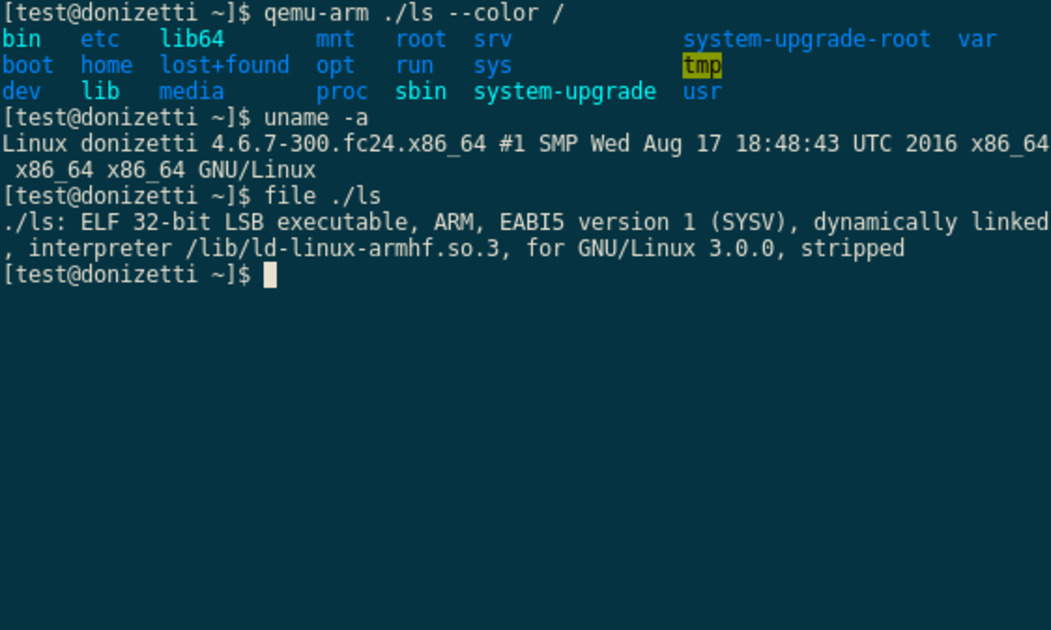
QEMU is the opposite trade-off: enormous device and architecture coverage, fast execution, and no pretence of cycle accuracy. It runs in two modes — full system emulation (a whole machine with firmware, kernel and devices) and user-mode emulation (a single binary for another architecture). Installation is a plain package install:
| |
Two details matter in practice. First, -M virt is a generic virtual platform: you must supply the device tree or let QEMU generate one, and the console device name (ttyAMA0 on ARM virt) has to match your kernel command line — a mismatch produces silence, which people misdiagnose as a broken image. Second, -accel kvm only works when guest and host architectures match; everything else falls back to TCG, which is correct but slower.
QEMU is also the foundation other layers sit on. If you want a management UI rather than command lines, the same hypervisor is typically driven through libvirt — our self-hosted KVM web management comparison covers Cockpit, Kimchi and WebVirtCloud. For sandboxing workloads where isolation matters more than emulation fidelity, the microVM platform comparison is the better read.
Where QEMU hurts: timing is not reproducible, so tests that depend on wall-clock behaviour are flaky. Device models are functional — they will not tell you whether an interrupt lands late under load.
gem5 — Architectural Fidelity, Deliberately Slow
gem5 (BSD-3-Clause, developed by the academic community) simulates microarchitecture: pipelines, caches, memory controllers, interconnect. The build is SCons-based and takes a while:
| |
Important 2026 detail: the old configs/example/se.py entry point is deprecated — running it prints a fatal message directing you to configs/deprecated/example. The supported path is the stdlib configuration library under configs/example/gem5_library/, which ships ready-made scenarios:
| |
The library covers ARM, RISC-V and x86 demos (arm-ubuntu-run.py, riscv-ubuntu-run.py, riscvmatched-hello.py, power-hello.py, and a KVM-assisted variant), so you can start from a working configuration instead of writing a platform from scratch. Note that gem5’s official Docker Hub image is marked deprecated; container builds now come from util/dockerfiles in the repository.
Where gem5 hurts: speed. Full-system simulation of an Ubuntu boot can take hours, and that is by design — you are paying for detail. Treat gem5 as a batch workload for a scheduler (see our HPC workload manager comparison if you run many configurations), never as a per-commit gate.
Wiring All Three Into One Pipeline
The pragmatic split most teams land on: Renode on every pull request, QEMU nightly for kernel integration, gem5 weekly for architectural regression. That maps cleanly onto container images:
| |
Because all three accept firmware binaries and emit deterministic text output, the same pipeline can assert on UART strings, exit codes, and gem5 statistics dumps without any vendor tooling. If you are also generating HDL, keep the open-source FPGA toolchain guide next to this one — simulation and synthesis belong in the same pipeline stage. And if the firmware itself runs an RTOS, the choice of kernel changes what your emulator has to model: see the Zephyr vs NuttX vs RIOT OS comparison.
Pitfalls That Cost Real Days
- Silent console = wrong console device. A QEMU guest that prints nothing usually has a
console=mismatch with the emulated UART, not a broken kernel. - Do not test timing under TCG. Instruction-count-based delays look fine in emulation and fail on silicon. Use logical waits in tests.
- Renode device models are not exhaustive. Check the platform description
.replfiles for your SoC before promising your manager a fully emulated board. - gem5 scripts moved. Copy-pasting a five-year-old tutorial that calls
configs/example/se.pywill abort immediately; migrate togem5_library. - Multi-node networking needs explicit topology. Two emulated boards will not see each other unless you wire the virtual interfaces — this is scripted, not automatic.
- Pin image tags.
lateston an emulator image can change device models under you; pin a digest for reproducible CI. - Emulation does not cover radios, power or analog. Budget bench time for anything involving RF, current draw, or sensor physics.
FAQ
Should I replace my dev boards with emulation entirely? No. Use emulation to run tests on every commit and keep real boards for what emulation cannot model: analog behaviour, RF performance, power draw, and final integration. Teams that remove hardware entirely usually reintroduce it after their first field failure.
Is Renode cycle-accurate? No. Renode is a functional and timing-oriented simulator built for software development and CI. If you need cycle-level accuracy for pipeline or cache analysis, that is gem5’s job.
Can QEMU run the firmware of a Cortex-M microcontroller? Sometimes. QEMU has machine types for several Cortex-M boards, but its peripheral coverage is much thinner than Renode’s for microcontroller targets. For MCU firmware testing, Renode is usually the better fit.
How slow is gem5 compared to QEMU? Orders of magnitude slower — a full-system Ubuntu boot can take hours versus seconds in QEMU. Use gem5 where the detail justifies the wall-clock cost, and run it in batch rather than interactively.
Which of the three is easiest to put in CI?
Renode, because renode-test produces machine-readable pass/fail results and the container starts headless in seconds. QEMU is a close second with a simple docker run and -nographic, but you have to write your own assertions.
Do I need a license to use these commercially? QEMU is GPL-2.0, gem5 is BSD-3-Clause, and Renode is MIT-style. Running them as tools in your pipeline carries no per-seat cost; only shipping modified binaries triggers the usual copyleft obligations.
💰 想测试你的市场判断力?我用 Polymarket 做预测市场交易——这是全球最大的预测市场平台,从大选结果到技术监管时间线,什么都可以押注。和赌博不同,这是真正的信息市场:你懂的信息越多,胜率越高。我靠预测技术相关事件的走向已经赚了不少。用我的邀请链接注册:Polymarket.com