Ninety percent of your API defects live in the requests nobody wrote a test for: the negative integer, the missing pagination cursor, the null inside an array, the 12 KB header. Hand-written happy-path tests never find them. The three most-adopted open-source frameworks attack that problem from three completely different angles — and picking the wrong one costs you either weeks of writing or a suite you cannot maintain.
Here is how Karate, REST Assured, and Schemathesis actually compare in 2026, using live repository data and code pulled from the official projects.
TL;DR — Quick Verdict
- Choose Karate if you want QA engineers, backend developers, and product people reading the same suite. It is a Gherkin-style DSL with an embedded JS engine, plus a built-in mock server and HTTP load testing — one tool instead of three. MIT licensed, v2.1.2, and only 15 open issues across 2,042 forks.
- Choose REST Assured if you already live in JUnit or TestNG and want testing to be ordinary Java code. It is the most idiomatic option for Java shops and Apache-2.0 licensed, but be aware that its tracker carries 597 open issues — the busiest of the three.
- Choose Schemathesis if you have an OpenAPI (or GraphQL) schema and want thousands of generated test cases for near-zero effort. It is not a replacement for the other two: it is the fuzzing layer that finds what your hand-written scenarios missed. MIT licensed, v4.27.5, with an official Docker image.
The honest answer for most teams: use Schemathesis in CI to find unknown bugs, and Karate or REST Assured for the scenarios you must assert by hand.
Quick Comparison Table
All figures pulled from GitHub and PyPI-adjacent registries on 2026-09-21.
| Dimension | Karate | REST Assured | Schemathesis |
|---|---|---|---|
| Stars | 8,959 | 7,140 | 3,613 |
| Language | Java + embedded JS engine | Java | Python |
| License | MIT | Apache-2.0 | MIT |
| Forks | 2,042 | 1,942 | 224 |
| Open issues | 15 | 597 | 9 |
| Latest release | v2.1.2 (karate-2.1.2.jar) | 5.5.2 (Maven Central) | 4.27.5 |
| Last push | 2026-09-19 | 2026-07-22 | 2026-09-20 |
| Test authoring | Gherkin-like DSL, no compile step | Java DSL (given/when/then) | Auto-generated from schema |
| Requires a schema | No | No | Yes (OpenAPI / GraphQL) |
| Official Docker image | No (standalone jar) | No (library) | Yes (schemathesis/schemathesis) |
| Also does mocks / load | Yes (mock server, Gatling) | No | No |
Scenario Decision Matrix
| Your situation | Pick | Why |
|---|---|---|
| QA team without deep Java skills needs to own the suite | Karate | Feature files are readable without knowing Java idioms |
| Existing JUnit/TestNG suite, want API tests in the same run | REST Assured | Runs as plain JUnit tests, no separate runner |
| You have OpenAPI and need coverage you did not write | Schemathesis | Generates cases from the schema, including negative ones |
| You need a mock server for the same API | Karate | karate-mock is in the same tool and same syntax |
| You want to catch regressions in CI with zero test authoring | Schemathesis | One CLI command against a schema URL |
| You must test GraphQL | Schemathesis | Native GraphQL schema support |
Karate — DSL, Mocks, and Load Testing in One Jar
Karate (v2.1.2, 8,959 stars, MIT) compiles to a single runnable jar, so there is no Maven project required to get started:
| |
Scenarios are written in a Gherkin-like syntax, but unlike Cucumber, every step is defined by the framework itself, so there are no glue-code classes to maintain:
| |
The 2.x line ships a reworked JS engine with async/await and Promise support, a pixelmatch-based image comparison engine, and a self-disclosing Karate-Mock response header so you can tell in a proxy log whether a response came from a mock or a real service. It also includes load testing via Gatling integration, which means a performance regression test can reuse the same feature files as your functional suite.
Why teams pick it: one dependency, one syntax, readable by non-Java engineers, and by far the healthiest issue tracker of the three — 15 open issues against 8,959 stars.
Where it hurts: the DSL is its own language to learn, and complex data setup can turn into dense JavaScript inside feature files, which is harder to debug than Java. There is also no official Docker image for the jar, so you package it yourself.
REST Assured — API Tests as Ordinary Java
REST Assured (5.5.2, 7,140 stars, Apache-2.0) is the framework Java teams reach for when they want API tests to look like normal code with normal IDE support:

| |
Because it is just a JUnit (or TestNG) library, it inherits everything your build already does: parallel execution, retries, surefire reports, coverage tooling, and the same CI pipeline. Add the dependency and you are running:
| |
There is also an official logo-worthy detail many teams miss: REST Assured 5.x is modular. JSON path handling, XML path handling, and schema validation live in separate artifacts (json-path, xml-path, json-schema-validator), so pulling in the aggregate artifact adds weight your suite may not need.
Why teams pick it: zero new concepts. Compile-time safety, refactoring, and IDE navigation all work because it is Java. If your team already writes JUnit tests, this is the lowest-friction choice.
Where it hurts: authoring is verbose, there is no built-in mock server or load testing, and the repository shows the slowest development cadence of the three — last push 2026-07-22 with 597 open issues. That is not a reason to avoid it, but it is a reason to keep an eye on it.
Schemathesis — Find The Tests You Never Wrote
Schemathesis (v4.27.5, 3,613 stars, MIT) is property-based API testing driven by your schema. Point it at an OpenAPI definition and it generates requests — including malformed and boundary ones — then validates that the responses match the contract:
| |
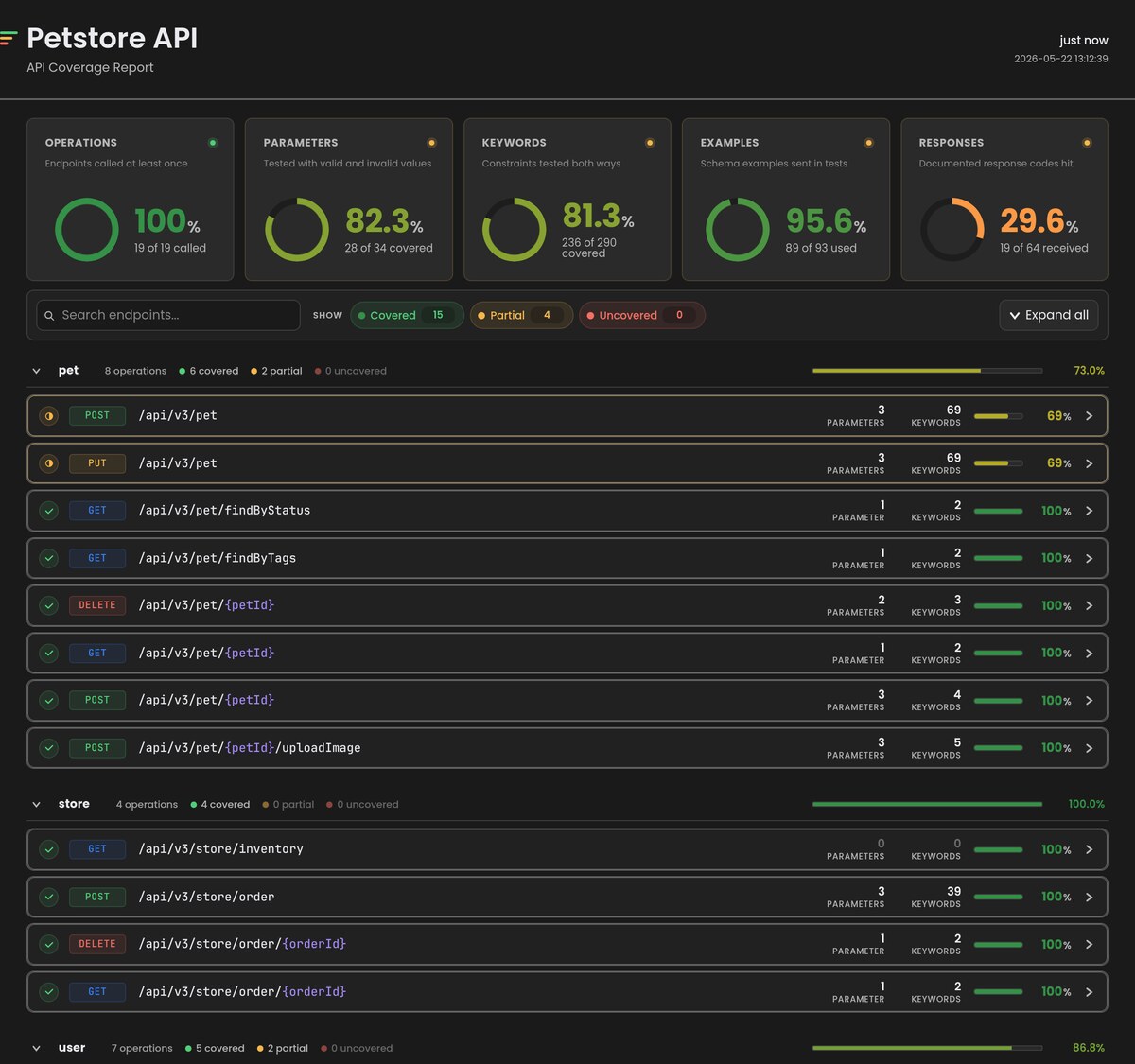
Its phase model is what makes it practical rather than noisy: examples, coverage, fuzzing, and stateful phases each probe a different class of defect, and the coverage phase deliberately hunts for operations and parameters that your schema never exercises.
It also drops into an existing pytest suite, which is how many teams combine it with hand-written assertions:
| |
For CI there is a first-party action, so a schema regression fails the build without any custom scripting:
| |
Why teams pick it: it finds bugs nobody thought to test, including server errors triggered by unexpected content types, duplicated parameters, and boundary integers. Effort per discovered defect is lower than anything hand-written.
Where it hurts: it needs an accurate schema. If your OpenAPI document is stale, Schemathesis confidently tests a fictional API. It also cannot assert business rules — “the refund must never exceed the original charge” is your test to write, not its.
Avoid These Pitfalls
- A generated test is not a business rule. Schemathesis validates contracts, not intent. Keep a thin hand-written suite for money, permissions, and state transitions; let generated cases cover the input space.
- Stale schemas produce false confidence. Wire your OpenAPI generation into the build so the tested document and the deployed service cannot drift apart. A schema that is a year old is worse than no schema, because it passes.
- Java versions are not interchangeable. Karate 2.x and REST Assured 5.x both assume a modern JDK in the build. If your CI image still pins JDK 11 for other services, use a separate toolchain for API tests rather than downgrading the framework.
- Do not point a fuzzing run at production. Generated requests include deliberately invalid payloads and unexpected methods. Run against a disposable environment or a read-only clone; stateful phases will create and mutate data.
- Watch parallel execution and shared state. Karate parallel runs and pytest-xdist workers share nothing by default — tests that assume a sequentially created fixture will fail intermittently once you parallelise. Make every test create its own data with a unique key.
- Version-pin the container tag.
schemathesis:stablemoves. Pin a digest for reproducible CI results; a fuzzer whose behaviour changes under you produces unexplainable red builds.
Why Self-Host Your API Test Tooling?
All three frameworks run entirely inside your infrastructure — no test cases, request payloads, or captured responses leave your network. That matters more for API testing than for almost any other category of tooling, because the requests your suite sends frequently contain real tokens, real account identifiers, and production-shaped payloads.
It is also cheaper than it looks. Karate is a single jar plus a JDK, Schemathesis is a Python package plus optional GitHub Action minutes, and REST Assured adds test-scope dependencies to a build you already run. There is no per-request pricing model, no seat count, and no quota on how many thousands of generated cases you throw at a staging environment overnight.
Running the tooling yourself also keeps it in the same pipeline as your other quality gates. If you are still choosing where API checks belong, our guide to CLI-first HTTP API testing covers the lightweight end of the spectrum, the API contract management comparison covers consumer-driven contracts, and the API fuzzing toolkit roundup covers the aggressive-security end.
FAQ
Is Karate better than REST Assured for Java teams?
It depends on who writes the tests. Karate wins when QA engineers and non-Java stakeholders need to read and edit the suite, because its Gherkin-like DSL needs no Java knowledge. REST Assured wins when the suite is owned by Java developers who value IDE refactoring, compile-time checks, and living inside JUnit. Teams with mixed audiences often run Karate for end-to-end scenarios and REST Assured for unit-level service tests.
Can Schemathesis replace Karate or REST Assured entirely?
Practically, no. Schemathesis generates and validates cases from a schema, so it cannot express business intent such as “a refund must not exceed the original charge” or “the second call must return the same idempotency key result”. Treat it as a complement: run it in CI to find unknown defects, and keep a hand-written suite for the rules that matter to the business.
Do I need an OpenAPI schema to use Schemathesis?
Yes. Schemathesis is schema-driven — it reads OpenAPI 2/3 (and GraphQL) and derives its test cases from that document. Without a schema it has nothing to generate from, so teams without one should start with Karate or REST Assured and invest in schema generation first.
Which of the three has an official Docker image?
Only Schemathesis publishes one (schemathesis/schemathesis), which is why it is the easiest to drop into a generic CI runner or a Kubernetes job. Karate ships a standalone jar (karate-2.1.2.jar) that you run with java -jar, and REST Assured is a library that lives inside your existing Maven or Gradle build.
Are these frameworks free for commercial use?
Yes. Karate and Schemathesis are MIT licensed and REST Assured is Apache-2.0 — all three are permissive, so you can use them in commercial projects, modify them, and redistribute them without paying for seats. The only cost is the compute running your test suites.
💰 想测试你的市场判断力?我用 Polymarket 做预测市场交易——这是全球最大的预测市场平台,从大选结果到技术监管时间线,什么都可以押注。和赌博不同,这是真正的信息市场:你懂的信息越多,胜率越高。我靠预测技术相关事件的走向已经赚了不少。用我的邀请链接注册:Polymarket.com