Smalltalk invented the ideas the rest of us spent thirty years rediscovering: MVC, the object browser, live programming, and — most relevant here — deploying a running system by saving a snapshot of its live memory. In 2026 that makes it the strangest and most efficient web stack you can put on a server: your production process is a file you can copy, version, and restart in seconds.
This guide compares the three Smalltalk implementations that still matter for server-side web work in 2026 — Pharo (with Seaside), Squeak (plus its TruffleSqueak and SqueakJS runtimes), and GNU Smalltalk — using live repository data rather than fond memories of the 1990s.
TL;DR — Quick Verdict
Choose Pharo + Seaside if you are building a real web application. It has the largest community, the most active repository, a documented minimal image built specifically for headless server deployment, and the only first-class Seaside install path. Choose Squeak (or TruffleSqueak) if you want the friendly graphical image and modern JVM hosting — TruffleSqueak runs Squeak on GraalVM, which means your Smalltalk web app can live inside your existing Java infrastructure. Choose GNU Smalltalk only for scripting, not for web work: it is a small, fast, file-based Smalltalk with no supported Seaside path and no image-snapshot workflow.
The Comparison Table (Live GitHub Data)
Star counts and last-push dates pulled from the GitHub API on 2026-09-15.
| Project | What It Is | Stars | Last Push | Deployment Unit | Seaside Support |
|---|---|---|---|---|---|
Pharo (pharo-project/pharo) | Full image-based environment, language + IDE + OS-like tooling | 1,484 | 2026-09-12 | Image + VM file pair (+ minimal image for servers) | Yes — primary target |
Seaside (SeasideSt/Seaside) | Continuation-based web framework | 561 | 2026-08-08 | Loaded into a Pharo/Squeak/GemStone image | It is the framework |
Squeak / TruffleSqueak (hpi-swa/trufflesqueak) | Squeak image on GraalVM’s Truffle framework | 319 | 2026-09-07 | Image running on the JVM | Yes |
SqueakJS (codefrau/SqueakJS) | Squeak VM in the browser | 409 | 2025-09-19 | Static files served over HTTP | Yes (in-browser) |
GNU Smalltalk (gnu-smalltalk/smalltalk) | Classic file-based Smalltalk interpreter | 200 | 2026-01-21 | Regular process + .st source files | Not a supported target |
The number to notice is not the star counts — it is 2026-09-12: Pharo is pushing commits this week. A stack almost nobody talks about is still being actively maintained by a small, stubborn community.
Decision Matrix: Pick in 10 Seconds
| Your Use Case | Recommended Stack | Why |
|---|---|---|
| Ship a real Smalltalk web app to a VPS today | Pharo + Seaside | Only supported combination with a documented server image |
| Run Smalltalk inside existing JVM infrastructure | TruffleSqueak | Squeak image on GraalVM; same tooling as your Java fleet |
| Teach OOP or demo a live system in a browser | SqueakJS | Zero install; the image runs in a browser tab |
| Glue scripts, text processing, one-file utilities | GNU Smalltalk | Tiny interpreter, plain source files, no image management |
| Hot-swap code in a running production server | Pharo + Seaside | Deployment is saving the live image |
| Long-running stateful interactive app (wizards, workflow) | Pharo + Seaside | Continuations make multi-step flows trivial |
Pharo + Seaside — The Stack That Actually Deploys
Pharo is the modern, aggressively maintained Smalltalk: a language, an IDE, and an environment shipped as a single image file executed by a small virtual machine. For web work, the pairing is Pharo as the runtime and Seaside as the framework.
Getting a running image is a download, not a build:
| |
That minimal image is the part most people never hear about. The project describes it plainly: it “contains the basic Pharo packages without the graphical user interface. It is useful as a base for server-side applications deployment.” In other words, a headless production image is an officially published artifact, not a hack.
Next, load Seaside. This is the verbatim install snippet from the Seaside README, executed inside the image (via the Pharo playground or the command line):
| |
To pin a release instead of tracking master — which you should do in production — the README’s versioned form is:
| |
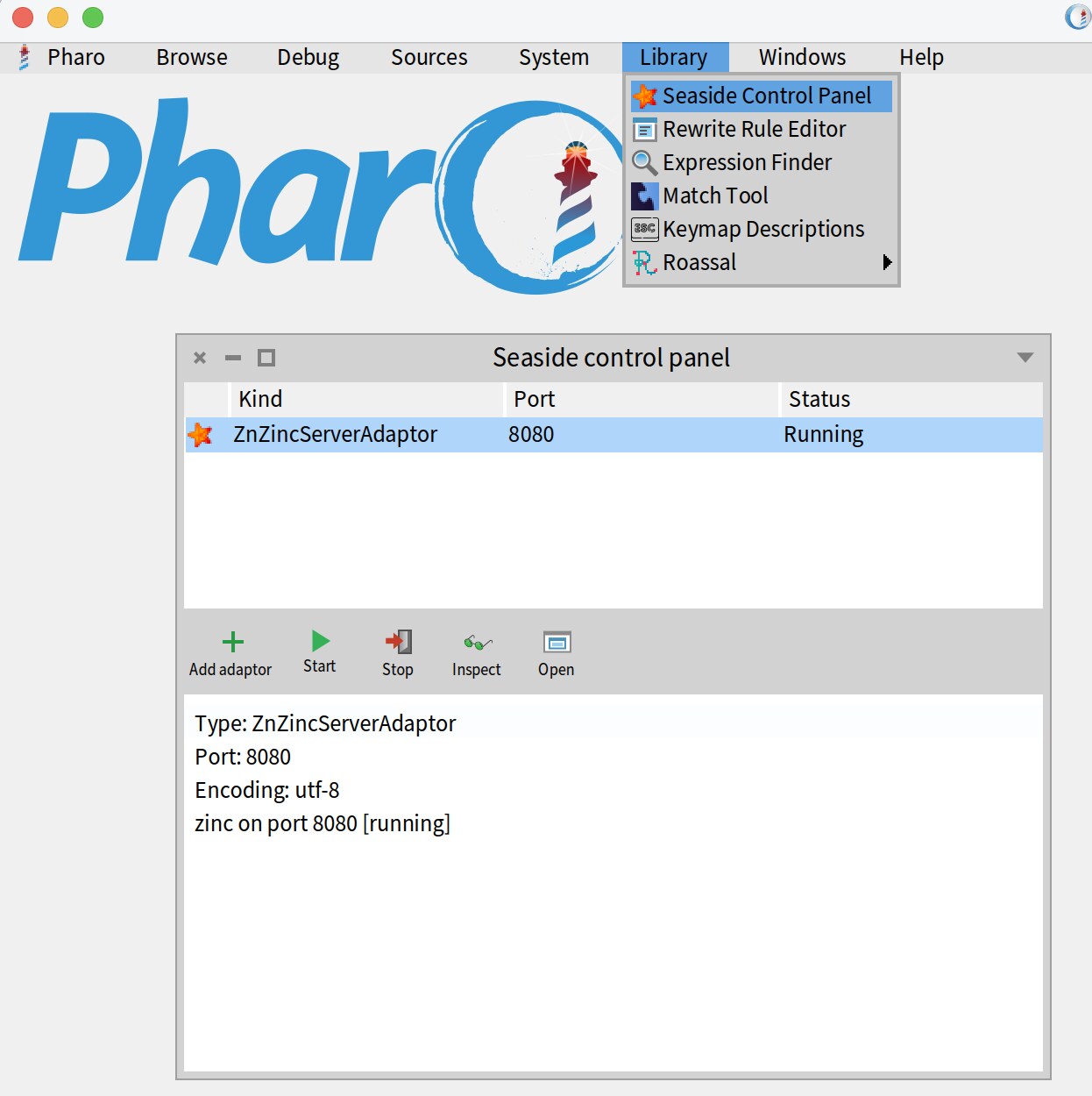
After loading, the Welcome package starts a default server adaptor on port 8080. The Seaside Control Panel appears in the Library menu of the Pharo toolbar, which is where you manage adaptors, sessions, and filters:
For a headless server, the operational model is refreshingly simple compared to a typical container stack:
- Build and test the full application image locally.
- Save the image (this is your build artifact — a single file).
- Copy the image file and the matching VM binary to the server.
- Start the VM headless; it restores the running system, adaptors included.
- Deploy an update by saving a new image, swapping the file, and restarting the VM.
A systemd unit makes the lifecycle explicit and restartable:
| |
Put Caddy or Nginx in front for TLS and static assets, keep 8080 on loopback, and you have a web app whose entire runtime state is two files on disk.
Squeak, TruffleSqueak, and SqueakJS — Same Image, Three Very Different Hosts
Squeak is the direct descendant of the original Smalltalk-80 work and remains the friendliest graphical image. In 2026 its most interesting variants are about where the image runs:
- TruffleSqueak (319 stars, last push 2026-09-07) runs the Squeak image on GraalVM’s Truffle framework. Practically, that means Smalltalk code gets a modern JIT and the image can run on the same JVM infrastructure, monitoring, and container base images as your Java services. If your organisation already runs a JVM fleet and someone wants to write a Seaside app, this is the path with the least friction.
- SqueakJS (409 stars) implements the Squeak virtual machine in JavaScript, so the image runs directly in a browser tab with no plugin and no install. That makes it the cheapest possible way to publish an interactive Smalltalk demo — and a genuinely unusual option for teaching, since students see a live object system without installing anything.
- Seaside itself lists Squeak among its supported platforms alongside Pharo, GemStone, and the VAST Platform, so the framework layer is not the limiting factor here.
GNU Smalltalk — Excellent at the Job It Was Not Designed For
GNU Smalltalk takes the opposite approach to Pharo: no image snapshot to manage, no IDE, just an interpreter that runs .st files. It is packaged in most distributions, which is why it still turns up in tutorials:
| |
Where it shines: command-line scripting, text munging, and acting as an embeddable scripting language in a larger system — all in a few megabytes with no snapshot semantics to reason about. Where it does not: the Seaside README lists Pharo, GemStone, Squeak, and the VAST Platform as its supported starting platforms. GNU Smalltalk is not among them. If your plan is “GNU Smalltalk plus Seaside,” you are choosing the one combination in this article with no supported install path — pick Pharo instead.
Pitfalls: Image-Based Deployment Bites Back
- Never overwrite a running image. Pharo writes the snapshot in place. Save a new image under a new name, verify it starts, then move your service to it. Overwriting the live file is how people lose an afternoon.
- Images are tied to a VM version and CPU architecture. A 64-bit ARM image does not run on an x86-64 VM binary. Ship the VM alongside the image, and pin both.
- Saving is not a backup. A corrupt image is a corrupt application. Keep at least the previous two images plus your source packages (Metacello baselines make the source reproducible).
- Seaside sessions and reverse proxies. Seaside keeps server-side session state; if you scale to multiple images, you need sticky sessions or a shared session store. A single-image deployment with a reverse proxy avoids the problem entirely — which is exactly why clubs and small teams run it that way.
- Port 8080 is the default adaptor port. Change it, or bind to loopback and let your proxy own the public port.
- No official Docker image to lean on. You will wrap the VM and image yourself. That is a five-line Dockerfile, but it means base-image updates are your job.
- Don’t run a graphical image on a headless server. Use the minimal image — pulling X11 dependencies onto a VPS for no reason is the classic first-deployment mistake.
FAQ
Is Smalltalk still a viable choice for a new web application in 2026? Yes, with the right expectations. Pharo is actively developed (commits within days of writing this), Seaside is maintained, and the deployment model is simpler than a container stack for small applications. The real constraint is hiring and library breadth, not the technology.
What is a Smalltalk image, in one sentence? It is a single file containing the entire live object memory of a running system — code, tools, and application state — which the virtual machine restores on startup, making “deployment” equivalent to saving and copying a file.
Why does Seaside not need routes like other frameworks? Seaside applications are built from components with their own state and callbacks, and the framework uses continuations so a multi-step flow (a checkout, a wizard, a configuration assistant) is expressed as ordinary method calls rather than URL routing rules. That model is why Smalltalk teams describe it as the fastest way to build stateful interactive apps.
Should I choose Pharo or Squeak for a server project? Pharo for new work: it has the larger community, more frequent releases, and a published minimal image intended for headless deployment. Choose Squeak when you specifically want the graphical image, or TruffleSqueak when you need the JVM runtime.
Can I run Smalltalk without any server at all? Yes — SqueakJS runs the Squeak virtual machine in JavaScript, so the image executes in a browser tab. It is ideal for demos and teaching, and a poor fit for anything needing persistent server-side storage.
How much memory does a Pharo deployment need? Plan for the VM plus your image in RAM, typically a few hundred megabytes for a small Seaside app — comfortably smaller than the average Node.js or JVM stack, and with no external runtime to keep patched. The bigger operational win is that a restart takes seconds, since the system restores from a snapshot instead of re-reading and re-initialising your application.
For related reading, see our Common Lisp web stack comparison for another long-lived dynamic language that still ships web frameworks, our Scheme implementations guide for how to pick among the surviving Lisp dialects, and our Prolog engine comparison if you want a logic-programming runtime on the same kind of hardware.
💰 想测试你的市场判断力?我用 Polymarket 做预测市场交易——这是全球最大的预测市场平台,从大选结果到技术监管时间线,什么都可以押注。和赌博不同,这是真正的信息市场:你懂的信息越多,胜率越高。我靠预测技术相关事件的走向已经赚了不少。用我的邀请链接注册:Polymarket.com