Object Pascal quietly runs a staggering amount of critical infrastructure: check-in terminals, laboratory instruments, warehouse scanners, and back-office systems that have been compiling with the same toolchain for fifteen years. The catch is that the server side of those systems is usually locked behind a commercial licence — until you look at what the open-source side has been doing.
Three options dominate in 2026: mORMot 2, DelphiMVCFramework, and fcl-web (fpWeb), which ships with Free Pascal itself. Two of them shipped commits within a day of this article. Here is the honest comparison, with live repository data and the actual code each framework expects you to write.
TL;DR — Quick Verdict
Pick mORMot 2 if you want the most capability per line of code: an optimised RTL, client/server ORM, SOA/MVC layers, JSON kernel, and nightly regression tests across Windows, Linux, macOS, and BSD — all under one roof. Pick DelphiMVCFramework if you are building a REST or JSON-RPC API and your team lives in the Delphi IDE: it gives you Richardson Maturity Model Level 3 REST, JSON-RPC 2.0 with automatic object remotisation, OpenAPI/Swagger generation, and TLS 1.3 negotiation out of the box. Pick fpWeb only when “no dependencies at all” is the requirement — it is part of Free Pascal’s own runtime library, so fpc is the entire installation.
The Comparison Table (Live GitHub Data)
Star counts and last-push dates come from the GitHub API on 2026-09-15.
| Framework | Repository | Stars | Last Push | Language Targets | Killer Feature |
|---|---|---|---|---|---|
| mORMot 2 | synopse/mORMot2 | 713 | 2026-09-14 | Delphi 7 → 12.3, FPC 3.2/trunk | Full ORM + SOA + MVC stack with an optimised RTL |
| DelphiMVCFramework | danieleteti/delphimvcframework | 1,404 | 2026-09-14 | Object Pascal (Delphi IDE workflow) | REST level 3 + JSON-RPC 2.0 + OpenAPI generation |
| mORMot 1.18 | synopse/mORMot | 825 | 2026-06-05 | Legacy Delphi/FPC | Maintenance-only; migrate to mORMot 2 |
| fcl-web / fpWeb | Ships inside Free Pascal (packages/fcl-web) | — | tracks FPC releases | FPC (all supported platforms) | Zero extra dependencies; TFPWebModule in the compiler’s own library |
Two data points matter more than the star counts: DelphiMVCFramework and mORMot 2 both pushed on 2026-09-14, and mORMot’s README states that regression tests are “built and run nightly from FPC fixes-3_2 to most versions of Windows 7-11, and several Linux and MacOS distributions on i386/x86_64/arm32/aarch64.” That is a wider CI matrix than most modern Node.js projects bother with.
Decision Matrix: Pick in 10 Seconds
| Your Use Case | Recommended Framework | Why |
|---|---|---|
| REST API with generated OpenAPI docs on day one | DelphiMVCFramework | Swagger/OpenAPI generation is a documented feature, not a plugin |
| One stack for ORM + services + HTML views | mORMot 2 | ORM, SOA, and MVC ship together with the RTL |
| Linux server binary, cross-compiled from Pascal | mORMot 2 with FPC | Explicit cross-platform server target list and nightly Linux testing |
| Existing Delphi team, minimal retraining | DelphiMVCFramework | IDE-first install plus a project template in the IDE menu |
| No dependency downloads allowed | fcl-web (fpWeb) | Distributed with the Free Pascal compiler |
| Maintaining a 2015-era mORMot 1.x codebase | Plan a mORMot 2 migration | Version 1.18 is explicitly in maintenance-only mode |
mORMot 2 — The Full Stack in One Repository
mORMot 2 is best understood as a complete Object Pascal platform rather than a web framework. The README describes it as an optimised RTL with a client-server ORM/SOA/MVC framework, and the repository layout backs that up:
src/— the library itself, includingsrc/rest/mormot.rest.http.server.pasfor the HTTP server layerex/— runnable samples, includingex/http-server-rawandex/http-server-files, each shipping both a.dpr(Delphi) and.lpi(Lazarus) projectstatic/— prebuilt.o/.objfiles needed for static linking on FPC and Delphipackages/lazarus/mormot2.lpk— the Lazarus package that compiles the whole library
Installing it in a Lazarus environment is therefore a two-step operation with no package manager involved:
| |
The README’s own instructions say the same thing in IDE terms: open and compile the .lpk, then build test/mormot2tests.dpr to run the regression tests locally. For a server project, copy ex/http-server-raw and adapt it — the samples are the documentation.
Two version constraints are worth memorising before you start:
- Use FPC 3.2.3 or the
fixes-3_2branch. The README flags a specific regression in FPC 3.2.2 involving variant late binding, and points at the upstream issue. - Delphi’s general units target Windows only. The README is explicit that on Delphi only the Windows target is available for the general units, that cross-platform client units work everywhere, and that “FPC is a much better and consistent cross-platform compiler.” If your deployment target is a Linux VPS or a BSD appliance, Free Pascal is the intended path — not a workaround.
Deployment on Linux is an ordinary compiled binary, which is exactly what makes this stack pleasant to operate:
| |
Put Nginx or Caddy in front for TLS and static assets, bind the API to loopback, and ship the binary as a single file. There is no interpreter to patch, no virtual environment to rebuild, and no lockfile to resolve at deploy time.
DelphiMVCFramework — REST and JSON-RPC for Delphi Teams
DelphiMVCFramework (DMVC) is the pragmatic choice when the team already has Delphi licences and wants standard HTTP semantics rather than a whole platform. Its feature list maps almost one-to-one onto what an API team is asked for: RESTful controllers following Richardson Maturity Model Level 3, JSON-RPC 2.0 with automatic object remotisation, MVC controller inheritance, a middleware pipeline, dependency injection, OpenAPI/Swagger documentation generation, full TLS 1.3 support with automatic negotiation of the highest available version, and a built-in ORM layer.
Installation follows the Delphi way of doing things. The official installation guide documents two methods:
| |
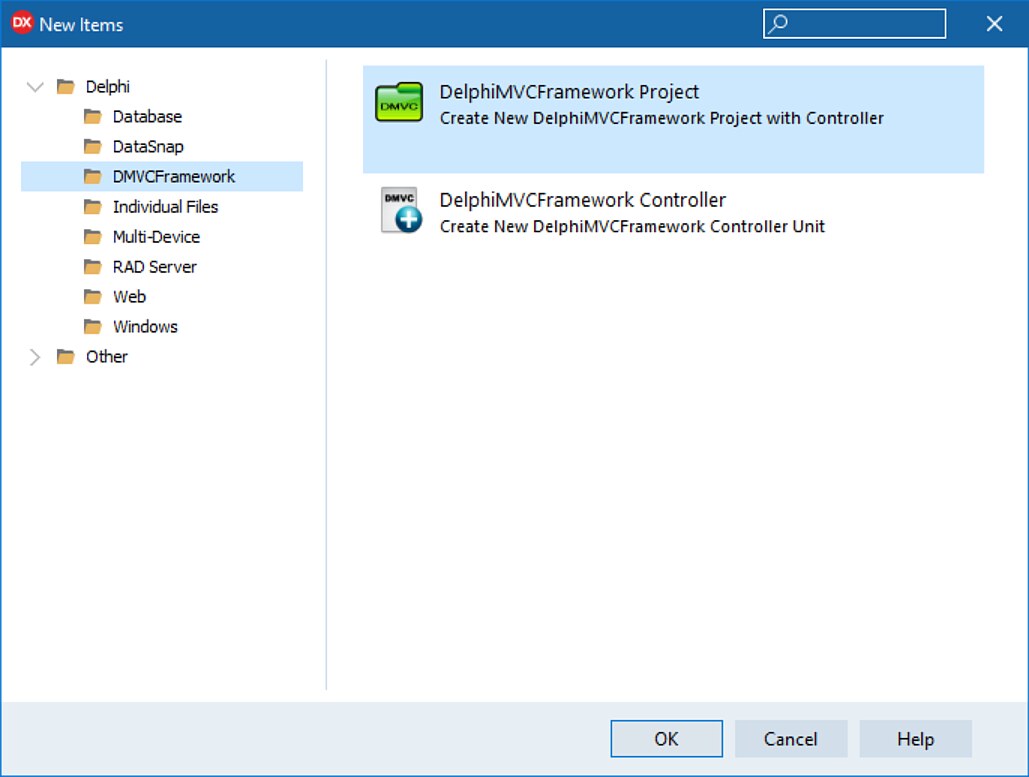
Once installed, the IDE gains a project template: the guide instructs you to verify that Delphi Project → DMVC → DelphiMVCFramework Project is available. That menu entry is the fastest path from an empty project to a running server.
Controllers are attribute-driven, which is why DMVC code stays readable. This is the framework’s own basicdemo_server sample controller, quoted from the repository:
| |
Read the path attributes carefully — /div/($par1)/($par2) is how DMVC expresses typed path parameters, and MVCProduces declares the response media type. There is no separate routing DSL to learn: the route lives on the method that serves it, which keeps controllers self-documenting.
fcl-web / fpWeb — The Option With Nothing to Install
Free Pascal ships a web package, fcl-web, inside the compiler’s own runtime library. The units you build on are real and stable — TFPWebModule, TFPWebAction, TFPWebActions, TFPWebTemplate, plus the TRequest/TResponse pair from the httpdefs layer. Because it is distributed with the compiler, “installation” is:
| |
What you get for that is a module/action dispatch model: a TFPWebModule owns a set of TFPWebAction objects, each with a name, a default event handler, and a URL pattern, and TFPWebTemplate renders dynamic HTML. What you do not get is an ORM, dependency injection, JSON-RPC, or OpenAPI generation. fpWeb is the correct answer for a small internal service or a server that must build on a machine where downloading third-party packages is not possible — and the wrong answer the moment your requirements include the words “OpenAPI” or “JSON-RPC.”
Pitfalls: Pascal Server Development in the Real World
- FPC 3.2.2 will bite you with mORMot 2. The variant late-binding regression documented in the project README produces confusing failures. Use 3.2.3 or the
fixes-3_2branch and save yourself the debugging session. - Delphi is not a Linux compiler for general units. Cross-platform server work belongs to Free Pascal. Teams that assume “Delphi can target Linux anyway” hit the README’s caveat late in the project.
- Static linking needs the bundled object files. Both compilers require the prebuilt
.o/.objfiles from mORMot’sstatic/directory when linking statically. Clone the repository; do not copy a subset ofsrc/. - Windows service vs Linux daemon. A Pascal server started as a console application behaves differently under a service manager — handle signals and shutdown paths explicitly, and always test a restart, not just a start.
- TLS certificates are your job. DMVC negotiates TLS 1.3 for you, but certificate issuance, renewal, and path configuration are deployment concerns. Terminating TLS at a reverse proxy is usually simpler than managing certificates inside the application.
- Migration is not optional for mORMot 1.x. Version 1.18 is maintenance-only. Its README asks users to upgrade to mORMot 2, and starting new work on 1.x means adopting a codebase nobody is extending.
- Sample code is version-sensitive. Both projects keep samples in-repo; when an attribute or unit name does not exist in your installed version, check the sample’s commit date against your release rather than rewriting from memory.
FAQ
Is Object Pascal still worth using for a new web service in 2026? Yes, in the specific case where your organisation already maintains Pascal code or Delphi licences. Both mORMot 2 and DelphiMVCFramework are actively developed, deploy as small native binaries, and avoid the runtime dependency churn that container-based stacks bring. For greenfield projects in a polyglot team, the hiring pool — not the framework — is the limiting factor.
What is the difference between mORMot 2 and DelphiMVCFramework? mORMot 2 is a platform: ORM, service layer, MVC, JSON kernel, RTL, and HTTP server, all in one repository with a single package to compile. DelphiMVCFramework is a focused web/API framework built around controllers and attributes, with strong REST and JSON-RPC support and OpenAPI generation. Choose by scope: platform versus framework.
Can I deploy either framework on a Linux VPS? Yes — with Free Pascal. mORMot 2 explicitly targets Windows, Linux, BSD, and macOS for servers and runs nightly regression tests on Linux distributions, while Delphi’s general units are Windows-only. The output is a native binary, which makes it easy to run under systemd behind a reverse proxy.
Do I need Lazarus to use mORMot 2?
No, but it is the smoothest path in 2026: the repository ships packages/lazarus/mormot2.lpk, and the README documents compiling it directly. Delphi users build the .dpr samples instead — just remember the Windows-only caveat for general units.
When should I use fpWeb instead of the other two?
When you need a small HTTP service with no third-party dependencies. fcl-web is part of the Free Pascal distribution and provides module/action dispatch and templating, but it does not provide an ORM, DI container, JSON-RPC, or OpenAPI generation. The moment any of those appears in your requirements, move to mORMot 2 or DelphiMVCFramework.
How do these compare on performance? All three compile to native code with no interpreter or garbage-collected runtime in the request path, which is why Pascal services are common in latency-sensitive industrial and point-of-sale systems. mORMot 2’s optimised RTL and JSON kernel are the most aggressively tuned of the three; fpWeb is minimal by design. Benchmark your own endpoints — allocation and database access will dominate, exactly as in any other stack.
For related reading, see our Java web frameworks comparison for the same framework-selection logic applied to a compiled, statically typed ecosystem, our F# web frameworks guide for another statically typed stack with a small deployment footprint, and our OCaml web frameworks comparison if you are weighing native-code web servers more broadly.
💰 想测试你的市场判断力?我用 Polymarket 做预测市场交易——这是全球最大的预测市场平台,从大选结果到技术监管时间线,什么都可以押注。和赌博不同,这是真正的信息市场:你懂的信息越多,胜率越高。我靠预测技术相关事件的走向已经赚了不少。用我的邀请链接注册:Polymarket.com