Formal verification stopped being an academic exercise. The people who verify software now ship it: CompCert’s verified C compiler runs in avionics toolchains, seL4 is a verified microkernel, and industrial teams write machine-checked proofs for authorization languages, cryptographic primitives and protocol state machines. The question in 2026 is no longer “should we use a proof assistant?” but “which one?” — and the answer changes your build system, your library ecosystem and how painful your next upgrade will be.
Three proof assistants dominate open-source practice: Rocq (the prover formerly known as Coq, coq/coq, 5,572 GitHub stars, latest release V9.2.0), Lean 4 (leanprover/lean4, 9,147 stars, v4.33.1) and Agda (agda/agda, 2,931 stars, v2.8.0.1). All three are free, all three are actively developed — and all three make you write proofs in a dependently typed language.
TL;DR — Quick Verdict
Choose Rocq if you are verifying software or algorithms that must survive a decade: it has the deepest classical library ecosystem (mathcomp, stdpp, Flocq), the most mature proof automation ecosystem (Ltac, SSReflect, Ltac2), and industrial deployment history. Choose Lean 4 if you want the fastest-moving toolchain, the richest mathematics library in the world (mathlib4, 4,111 stars and growing daily), and a functional programming language you can ship as an ordinary executable. Choose Agda if you care about proofs as programs — it is the cleanest environment for learning dependent types, has the most principled termination and coverage checking, and doubles as a executable programming language with excellent Haskell interoperability. For industrial verification, Rocq. For mathematics and momentum, Lean 4. For teaching and type theory, Agda.
Proof Assistant Comparison Table
Live GitHub data, 13 September 2026.
| Prover | Stars | Latest release | Logic / foundation | Tactic automation | Main library | Build tool | Official container |
|---|---|---|---|---|---|---|---|
| Rocq (Coq) | 5,572 | V9.2.0 (2026-03-27) | Calculus of Inductive Constructions | Ltac, Ltac2, SSReflect, lia/auto | mathcomp, stdpp, Flocq, Coq-community | dune, coq_makefile | coqorg/coq:8.20 |
| Lean 4 | 9,147 | v4.33.1 (2026-08-21) | Dependent type theory (CIC-like, proof irrelevance) | simp, omega, aesop, grind, <;> combinators | mathlib4 (4,111★) | lake | leanprovercommunity/lean:latest |
| Agda | 2,931 | v2.8.0.1 (2026-08-31) | Martin-Löf type theory (intensional) | Limited: Auto, RingSolver | agda-stdlib | cabal, Emacs mode / LSP | None official |
The star gap does not mean Lean is “better” — it means Lean’s community skews younger, more online and more concentrated in one repository. Rocq’s strength is distributed across dozens of mature Coq-community projects that predate GitHub stars mattering.
Decision Matrix: Pick by What You Are Proving
| Use case | Recommended prover | Why |
|---|---|---|
| Verifying C, assembly or compiler internals | Rocq | CompCert-grade tooling; mature VC generation and Flocq floating-point reasoning |
| Cryptographic proofs and protocol proofs | Rocq | mathcomp algebra hierarchy plus long-running verified crypto projects |
| Modern mathematics, research-level theorems | Lean 4 | mathlib4 is the largest formalised mathematics library available |
| Shipping executable verified code | Lean 4 | Compiles to native binaries; usable as a general-purpose functional language |
| Learning dependent types and type theory | Agda | Cleanest syntax, most readable error messages, most principled checker |
| Haskell-adjacent workflows | Agda | Direct Haskell FFI and cabal-based packaging |
| Large proof codebases you will maintain for years | Rocq | Conservative language evolution, backward-compatible releases |
| Fast-moving research with continuous library updates | Lean 4 | Weekly releases; toolchain versioned per project via lakefile |
Rocq (Coq) — The Industrial Standard
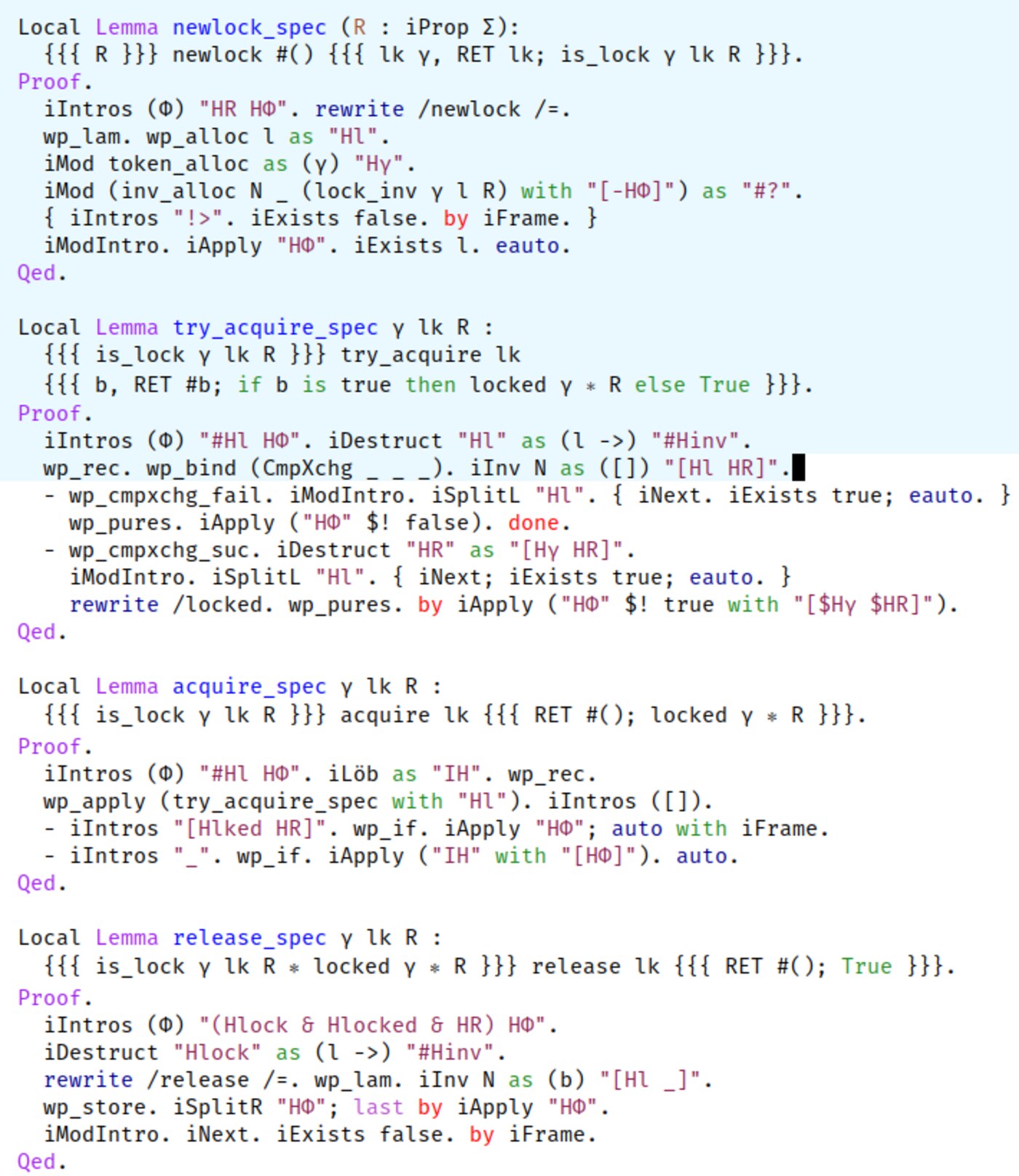
Rocq is a rename of Coq with a V9 release line and a reengineered kernel, but the ecosystem and proof language are continuous with the Coq you have seen in papers for two decades. That continuity is the selling point: your proofs from five years ago still compile, and the standard library stack (mathcomp, stdpp, Flocq, CompCert) has no equivalent breadth anywhere else.
Install it with opam (the recommended path for a specific V9 line):
| |
Or use the maintained container image for CI and isolated work:
| |
A small verified function with a real proof obligation:
| |
Where it wins: tooling maturity, library depth, and a language that changes slowly enough to build a decade-long codebase on. Where it costs you: Ltac is famously hard to debug, and the tactic-language churn between Ltac, SSReflect and Ltac2 means teams standardise on one style and stay there.
Lean 4 — The Fastest-Moving Prover
Lean 4 is both a proof assistant and a general-purpose functional programming language, with a self-hosted compiler that produces native binaries. Since the release of Lean 4 the project has attracted an extraordinary amount of industrial and academic participation: the official project pages showcase verified authorization engines, Rust verification toolchains, cryptographic libraries and mathematical formalisation at research scale.
Install with elan (the official toolchain manager — it pins the Lean version per project, which keeps mathlib-based work reproducible):
| |
Start a project and add the mathematics library:
| |
| |
Container-based CI:
| |
Where it wins: momentum. Tactic automation (simp, omega, aesop, grind) is genuinely usable, mathlib4 covers mathematics that no other library approaches, and the language is pleasant enough to use for ordinary programs. Where it costs you: mathlib4 moves fast enough that dependency breakage is a routine part of maintenance — you must pin toolchain versions in the lakefile and expect to spend real time on upgrades each year.
Agda — Proofs as Programs
Agda implements Martin-Löf type theory with a famously principled checker: all functions must be structurally terminating and all pattern matches exhaustive, and the errors it produces when they are not are the clearest in the field. That strictness makes Agda the best environment for learning dependent types, and a surprisingly practical language for writing verified small tools.
Install via cabal or a distribution package:
| |
A verified total function with a proof of a real property:
| |
Where it wins: the type system is the documentation, termination checking is not negotiable, and the syntax is the most readable of the three. Where it costs you: the ecosystem is small, there is no official container image, tactic support is minimal, and large developments require more manual proof engineering than Rocq or Lean.
Running Proofs in CI (and What It Actually Costs)
Proof checking is CPU-heavy and reproducible, which makes it a perfect CI job — and a bad candidate for compiling on every push if you can avoid it.
| Strategy | Rocq | Lean 4 | Agda |
|---|---|---|---|
| Cache compiled artifacts | dune/coq_makefile .vo files | lake exe cache get (mathlib) | cabal store + .agdai files |
| Typical first-build cost | Minutes for a mid-size development | Minutes without cache, hours with full mathlib from source | Minutes to tens of minutes |
| Reproducibility lever | Pin opam switch + image tag | Pin toolchain in lean-toolchain | Pin Agda version + stdlib commit |
| |
If you are exploring automated reasoning that does not require interactive proofs, our SMT solver comparison covers the solver-first approach, and the constraint programming solver roundup covers search-based modelling. For the tooling side of compiler-oriented work, see the Compiler Explorer guide.
Pitfalls and Migration Traps
- Pin your toolchain or your proofs will rot.
mathlib4and Lean move fast; Rocq and Agda move slowly but do break compatibility at major versions. Always commitlean-toolchain, an opam switch file, or an exact Agda version. PropversusBoolis not a style choice. Mixing computational booleans with propositions is the most common beginner trap and produces goals thatomegaorliacannot close. Decide early and keep proofs on the propositional side.- Termination checking will reject your natural formulation. Agda and Lean require structural recursion or an explicit well-founded measure. Rewriting a function to satisfy the checker often produces better code — but budget time for it.
- Universe polymorphism bites late. Both Rocq and Agda make you manage universe levels. Problems usually appear when a definition that worked at one level gets reused at another, deep inside a finished development.
- Never trust a proof you have not re-checked in CI.
Admitted,postulate, andsorryare silent holes. Grep for them in the pipeline and fail the build if they appear in a release branch. - Container images lag releases. The maintained Rocq image tracked the 8.20 line while the Rocq releases had already moved to V9.2.0 — for the newest kernel, install via opam rather than relying on the container tag.
- Do not benchmark proof assistants on runtime. The metric that matters is time to a checked proof: how quickly a team can state a theorem and get automation to close the routine parts.
FAQ
What is the difference between Rocq and Coq?
Rocq is the new name of the Coq proof assistant, with a V9 release line and a modernised kernel. The proof language, libraries and community remain continuous, which is why you still see coq everywhere in tooling names, Docker tags and package managers.
Is Lean 4 better than Coq for mathematics?
For contemporary research mathematics, Lean 4 currently has the stronger story because mathlib4 is the largest single formalised mathematics library and is updated continuously. For verified software, cryptography and long-lived industrial proof codebases, Rocq’s mature library stack and conservative evolution are usually the better fit.
Which proof assistant is easiest to learn?
Agda, for the type theory itself — its syntax, error messages and termination checking are the clearest of the three. Lean 4, for getting to a useful result quickly, because simp, omega and aesop close a large fraction of routine goals automatically.
Do I need a proof assistant to use formal methods? No. If your problem is “is this configuration or constraint system satisfiable”, an SMT solver or constraint solver will be faster to adopt. Proof assistants are for statements you need to be certain about for the life of the software — correctness of a compiler pass, a cryptographic primitive, a protocol invariant.
Can I run proofs in Docker or Kubernetes?
Yes. coqorg/coq:8.20 and leanprovercommunity/lean:latest are maintained images, and Agda builds fine from a Haskell-based image. Cache compiled artifacts in a volume — proof checking is CPU-bound and re-checking everything on each run wastes minutes per build.
How big are real verified developments? Large: verified compilers and microkernels are multi-year, multi-person projects measured in hundreds of thousands of lines of proof. But you do not need that scale to benefit — a few hundred lines proving the invariant of a critical function is already a good return on investment.
💰 想测试你的市场判断力?我用 Polymarket 做预测市场交易——这是全球最大的预测市场平台,从大选结果到技术监管时间线,什么都可以押注。和赌博不同,这是真正的信息市场:你懂的信息越多,胜率越高。我靠预测技术相关事件的走向已经赚了不少。用我的邀请链接注册:Polymarket.com