Your page feels slow, and the culprit is almost never the network — it’s the main thread. Every third-party script, every DOM mutation, every JSON parse runs on the one thread that also has to paint pixels and answer clicks, and browsers give you exactly one escape hatch: Web Workers. The problem is that Workers are hostile to work with — postMessage and structured cloning make even a counter tedious. Three open-source projects exist to fix this, and they fix different problems: Comlink (12,784 stars) removes the RPC boilerplate, Partytown (13,762 stars) moves third-party scripts wholesale, and worker-dom (3,263 stars) relocates DOM itself. Picking between them without knowing which layer each one owns is how teams end up with a worker architecture that’s slower than the original.
TL;DR: Which Web Worker Library Should You Use?
If you have your own heavy code (parsing, crypto, image processing, search) and just want it in a worker without postMessage ceremony, use Comlink — it turns a worker into a plain async object. If your problem is third-party scripts (analytics, chat widgets, marketing pixels) stealing main-thread time, use Partytown — it rewrites those scripts to run in a worker with zero changes to their calls. If you’re building an embeddable, content-heavy component where DOM rendering itself is the bottleneck, evaluate worker-dom — it runs a real DOM API in a worker. These are not competitors: they compose. The common architecture is Comlink for your own modules, Partytown for the vendor junk, and worker-dom only when rendering work itself must leave the main thread.
Comparison at a Glance
| Comlink | Partytown | worker-dom | |
|---|---|---|---|
| Stars | 12,784 | 13,762 | 3,263 |
| Last push | 2026-08-11 | 2026-08-25 | 2026-08-20 |
| License | Apache-2.0 | MIT | Apache-2.0 |
| What it moves | Your code (via RPC) | Third-party scripts | DOM operations |
| API surface | wrap / expose proxies | Script tag attribute + config | upgradeElement |
| Vendor script support | No | Yes (Google Analytics, GTM, etc.) | No |
| Sync main-thread access | No (async only) | Yes (Atomics-based) | Via DOM patches |
| Bundle size | ~1 KB | ~7 KB | ~40 KB (main) + worker |
| Production status | Stable, widely used | Beta (documented trade-offs) | Experimental (AMP lineage) |
| Browser support | All worker-capable browsers | Modern (needs service worker + Atomics) | Modern |
Decision Matrix: Pick by Use Case
| Use Case | Recommendation | Why |
|---|---|---|
| Move your image/parsing/search code off main thread | Comlink | Wrap the worker once; call it like a local module |
| Kill the main-thread cost of analytics/tag managers | Partytown | Vendor scripts need zero code changes |
| Embed heavy third-party content in a sandboxed area | worker-dom | DOM work for that subtree happens in a worker |
| Multiple workers sharing typed APIs | Comlink | Proxies + transferables keep the plumbing invisible |
| E-commerce site drowning in marketing scripts | Partytown | It was built for exactly this (Builder.io, Qwik ecosystem) |
| Component that must stay responsive during render | worker-dom | Main thread keeps priority for interaction |
Comlink: RPC for Workers Without the Boilerplate
Comlink is the smallest idea that changes everything: instead of worker.postMessage() and onmessage handlers on both sides, you get an async proxy. In the main thread you wrap the worker and call its methods like normal functions; inside the worker you expose an object. Comlink handles the message channel, serialization, errors, and even callbacks.
| |
| |
The rule of thumb Comlink’s README hammers home: if you’re using the proxy, put await in front of it — every property access and call is asynchronous, and exceptions are re-thrown on the caller side. Two primitives cover the edges: Comlink.transfer(value, transferables) hands ArrayBuffers to the worker without copying (zero-copy for large binary payloads), and Comlink.proxy(fn) passes a function reference so the worker can call back into the main thread. That combination — proxy in, transfer for bytes, proxy for callbacks — handles almost every real worker design, and it does it in about a kilobyte. It’s Apache-2.0, Google-maintained, and stable enough that it’s embedded in production tooling across the web. If your mental model of workers is the Node.js side of the same problem, our Piscina vs workerpool vs poolifier comparison covers the server-side equivalent.
Partytown: Send Third-Party Scripts to the Worker
Partytown attacks a different enemy: the vendor scripts that you didn’t write and can’t refactor — analytics, tag managers, A/B testing, chat widgets. Their main-thread cost is real: each one parses, evaluates, and mutates the DOM, and they compete with your code for the same thread. Partytown’s philosophy is blunt: the main thread belongs to your code; everything else can wait in a worker.
The integration is a script-tag attribute. You configure a forward list for the globals the vendor scripts will call, load Partytown, and mark the vendor scripts with type="text/partytown":
| |
Partytown runs those scripts in a Web Worker backed by a service worker, and its sync-communication layer (Atomics + eval) lets the worker read and write the main thread’s state — including document, localStorage, and cookies — with the same semantics the scripts expect. That’s what makes it “drop-in”: Google Analytics and tag-manager integrations work with their standard snippets. The trade-offs are documented honestly: some APIs can’t be fully synchronized, it’s labeled beta, and it only pays off when third-party script weight is actually significant. The picture below — from the project’s own README — shows the difference: without Partytown, your code and third-party code fight for the main thread; with it, vendors are quarantined in the worker.
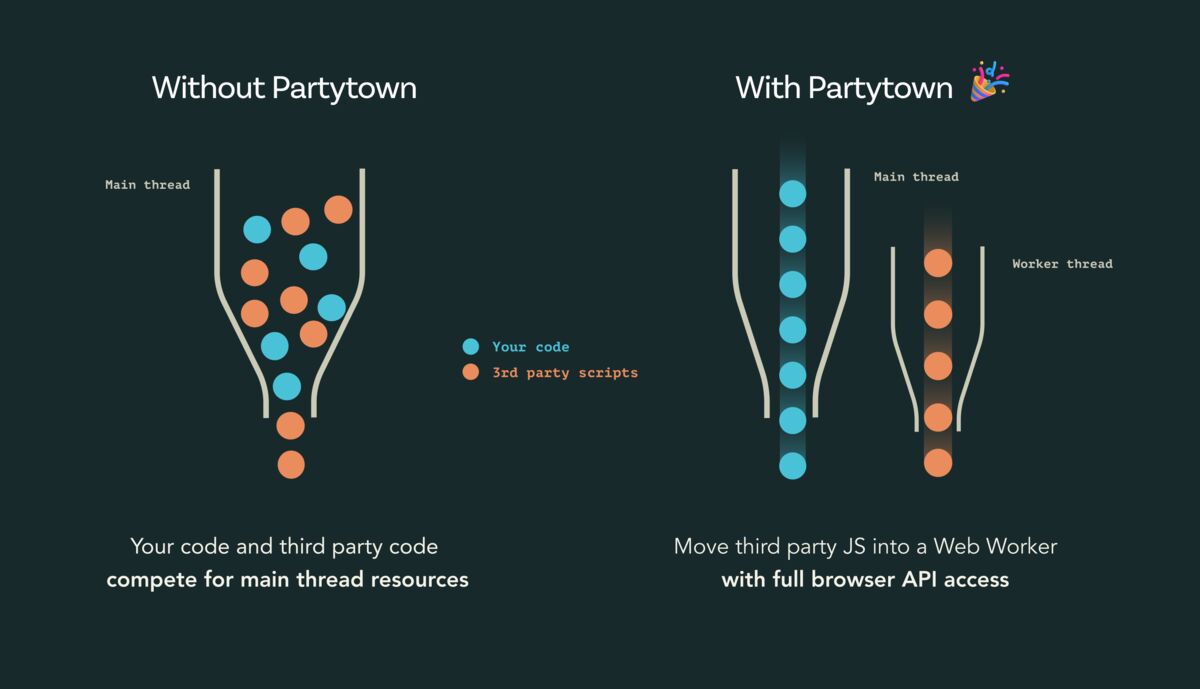
The context matters: Partytown is built by Builder.io and is part of the Qwik ecosystem’s performance story (their headline claim was cutting 99% of JavaScript with Qwik + Partytown). It’s MIT-licensed, pushed within the last week, and the most directly actionable tool here if your performance budget is being eaten by vendor code. One caution: measure first — on a site with little third-party weight, Partytown’s worker and service-worker overhead can exceed what it saves.
worker-dom: The DOM API, Inside a Worker
worker-dom is the most ambitious of the three: an implementation of the DOM API that runs inside a Web Worker, sending only the necessary mutations to the foreground thread. Its stated purpose is to move “intermediate work related to DOM mutations” off the main thread — so a subtree of your page (typically embedded content from a third party) can be driven entirely from a worker, while the main thread stays free for high-priority interaction.
You upgrade a specific element to be worker-driven:
| |
| |
With the module variant in place, the div’s entire subtree is rendered by the worker, and mutations are diffed and shipped to the main thread — the main thread only does the final paint work. It grew out of AMP (amp-script uses it to sandbox third-party content), which shows in its design: it’s built for embedded, quarantined content rather than for relocating your whole app. That’s also its limitation — it’s an in-progress, experimental implementation, and the DOM surface is not 100% complete, so exotic APIs can trip it. But for the specific use case of “embed heavy third-party content without letting it jank my page,” there is no other open-source option with this architecture. Apache-2.0, pushed recently, and worth a spike if you build embeds.
Common Pitfalls and Migration Traps
Workers are not free. Spawning a worker has real startup cost (a new isolate, a fresh event loop, message channel setup). Moving a 5 ms task into a worker can make the total path slower. Profile first: Comlink’s README and Partytown’s docs both warn that off-threading only wins when the moved work is substantial or long-running.
Structured cloning is the hidden tax. Comlink’s zero-copy transfer only applies to transferables (ArrayBuffers, MessagePorts, ImageBitmaps). Plain objects and typed arrays get cloned — and cloning a large object graph can take longer than the task itself. Design your worker payloads as flat buffers, not nested objects.
Partytown’s sync access has edges. Some vendor patterns (synchronous document.write, certain window reads at load time) don’t survive the relocation. The FAQ lists them; test your specific vendor scripts with the debug mode before trusting production numbers. And because it depends on a service worker plus Atomics, it’s a modern-browser-only strategy.
worker-dom is not a drop-in app framework. You can’t load React into a worker-dom worker and expect every React feature to work — the DOM subset is incomplete. It shines for sandboxed embedded content (its AMP lineage), not for re-architecting your application. Read the known-limitations list before committing.
Cookie/localStorage semantics differ per tool. Comlink gives you none (you design it), Partytown synchronizes them via its communication layer, and worker-dom doesn’t solve them at all. If your worker code needs storage access, verify the behavior in each tool rather than assuming parity.
Keep the main thread for interaction. The entire point of this family of tools is that the main thread should never be blocked. A common anti-pattern: moving work to a worker, then await-ing it synchronously in a way that re-blocks rendering. Off-thread work should be fire-and-update — show a placeholder, update when the worker responds.
Migrating a legacy main-thread codebase. Start with Comlink on the single most expensive function (search, parse, transform). Keep the original synchronous path behind the same interface; flip the implementation to the worker behind a feature flag. Only reach for Partytown or worker-dom when vendor scripts or embedded content are the measured bottleneck — and measure before and after with real field data.
FAQ
Are Comlink, Partytown, and worker-dom competitors?
Not really — they solve different layers of the same problem. Comlink removes RPC boilerplate for your own worker code, Partytown relocates third-party scripts into a worker without code changes, and worker-dom runs DOM operations for an embedded subtree inside a worker. Many sites use Comlink and Partytown together.
What does Comlink actually do?
Comlink turns a Web Worker into an async object: Comlink.wrap(worker) returns a proxy whose methods you can call and await, and Comlink.expose(obj) in the worker makes that object available remotely. It replaces postMessage/onmessage plumbing, including error propagation and callback passing.
Is Partytown production-ready?
Partytown is labeled beta but is widely deployed on high-traffic sites, especially in the Qwik ecosystem. The docs list explicit trade-offs (some sync APIs behave differently, modern browsers only). Test your specific vendor scripts with its debug tooling before trusting production metrics.
When should I use worker-dom instead of Comlink?
When the DOM work itself is the bottleneck — for example, rendering a large embedded component or third-party content. worker-dom runs a DOM implementation inside the worker and ships only the necessary mutations to the main thread. For ordinary CPU work (parsing, computation), Comlink is simpler and sufficient.
Do these libraries work with module workers and bundlers?
Comlink and worker-dom are ESM-friendly and bundle cleanly with Vite/webpack/Rollup; Comlink also ships UMD builds. Partytown is served as a static script with a service worker, so it integrates with any build system but has its own copying/placement steps. Check each project’s docs for bundler-specific notes.
What about WebAssembly and workers?
WebAssembly modules run natively inside workers, so the combination is powerful: a WASM module doing heavy work in a worker, exposed to the main thread through Comlink’s proxy. For the server side of that story, see our WASM runtime comparison. For reference, heavy browser tooling like code editors — covered in our Monaco vs CodeMirror vs Ace guide — is exactly the kind of workload these off-threading patterns are built for.
💰 想测试你的市场判断力?我用 Polymarket 做预测市场交易——这是全球最大的预测市场平台,从大选结果到技术监管时间线,什么都可以押注。和赌博不同,这是真正的信息市场:你懂的信息越多,胜率越高。我靠预测技术相关事件的走向已经赚了不少。用我的邀请链接注册:Polymarket.com